Pressure vessel inspection services for API 510 and NDT
Pressure vessel inspection services check the shell, heads, nozzles and welds of a process vessel, air receiver or heat exchanger against API 510 so you know it can stay in service. An API 510 authorized inspector leads the job and NDT crews supply the method work: ultrasonic thickness grids, phased array (PAUT) or time of flight diffraction (TOFD) on welds, magnetic particle and penetrant testing for surface cracks, and radiography where a record is required. In the US an external in service inspection typically costs $1,200 to $5,000 per vessel and an internal inspection with weld NDT $3,000 to $15,000, before shutdown, cleaning and scaffolding.
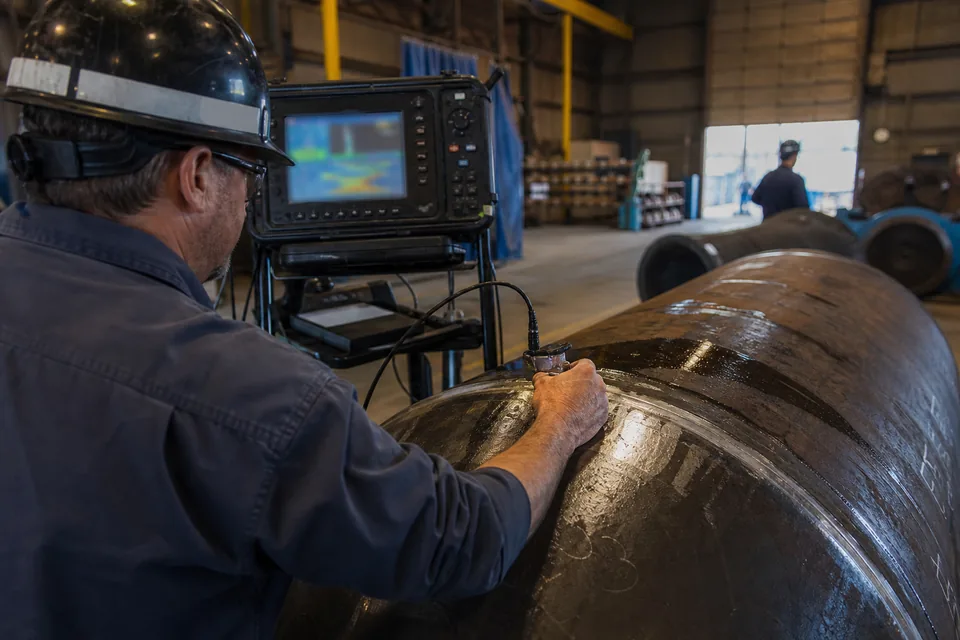
Which method inspects which part of a pressure vessel
| Vessel part | Method | What it finds | Typical US range per vessel |
|---|---|---|---|
| Shell and heads | UT thickness grid, corrosion mapping | General wall loss, pitting, corrosion under insulation spots | $800 to $3,500 |
| Longitudinal and circumferential welds | PAUT, TOFD or radiography | Lack of fusion, cracks, slag, porosity | $1,500 to $6,000 |
| Weld surfaces and repairs | Wet fluorescent MT or dye penetrant | Surface cracks, hydrogen damage, fatigue cracks | $600 to $2,000 |
| Nozzles and manways | UT thickness, PT, MT | Corrosion at the neck, cracks at the reinforcing pad weld | $500 to $2,000 |
| Insulated vessels | Insulation removal spots, profile radiography, pulsed eddy current | Corrosion under insulation (CUI) | $1,500 to $6,000 |
| Internal surfaces | Remote visual or borescope | Pitting, coating failure, internal cracking | $600 to $2,500 |
| Hot spots and refractory lined vessels | Infrared survey | Refractory loss, hot shell areas | $500 to $1,800 |
These are planning ranges, not quotes. Vessel size, material, operating temperature, access and the report you need change the real price, and several vessels at one plant cost less per vessel than a single call out.
API 510 sets who inspects and how often
API 510 covers the in service inspection, repair, alteration and rerating of pressure vessels built to ASME Section VIII. The owner or user must have an authorized inspector sign off the records. Intervals come from measured corrosion rates and remaining life: the internal or on stream inspection can be no longer than half the remaining life or ten years, and external inspections follow at most every five years unless a risk based inspection (RBI) program says otherwise. The thickness data you buy now therefore decides how long you wait for the next outage. Ask the contractor to state which API 510 clause each scope item answers, and have the report show remaining life by component.
Weld NDT on pressure vessels, PAUT, TOFD and radiography
Weld seams are the part of a vessel most often questioned by an inspector or a customer. PAUT and TOFD give a sized, recorded image of a flaw and are the usual choice on thick walls, while radiography is still specified on new construction and repairs where the code asks for film or digital images. Surface methods catch the cracks that volumetric methods miss. For the method background see ultrasonic testing services, radiographic testing and weld X-ray inspection and magnetic particle inspection. Piping attached to the vessel is covered under pipe weld testing.
Corrosion under insulation and in service thickness
Most unplanned vessel repairs trace back to wall loss nobody measured. Corrosion mapping with automated UT shows thinning as a color map instead of a few spot readings, and it is repeatable, so next year's scan compares point for point. Insulated vessels need a plan for corrosion under insulation: remove insulation at the likely spots, or screen with profile radiography or pulsed eddy current first. Tank farms with vessels and tanks together can combine the visit with a storage tank inspection.
Who buys pressure vessel inspection
Refinery and chemical plant reliability engineers buy API 510 inspections on a schedule set by their RBI program. Food, beverage and pharmaceutical plants order them for steam, air and process vessels before insurer audits. Power plants and manufacturers need them for feedwater heaters, air receivers and autoclaves. Fabricators and repair shops order weld NDT after a repair or alteration. Buyers of a plant order a baseline inspection of every vessel during due diligence.
How a pressure vessel inspection job runs
- You send vessel tag, size, design pressure and temperature, material, year built, product and the last inspection report.
- The inspection company proposes a plan: on stream or internal, methods, crew and access. Internal work needs the vessel isolated, cleaned and gas free first.
- Crews mobilize, complete site safety and permit steps and inspect in the agreed window. Confined space entry needs a permit, an attendant and a rescue plan.
- Data is reviewed by a qualified technician and the API 510 inspector, who assigns remaining life and repair priorities.
- You receive a report with thickness maps, weld results, a defect list, corrosion rates, a recommended interval and repair recommendations. Urgent findings are called in the same day.
What pressure vessel inspection costs
Shutdown, cleaning and scaffolding often cost more than the inspection itself. Ask whether the quote includes them.
- External in service API 510 inspection. $1,200 to $5,000 per vessel, depending on size and the number of thickness points.
- Internal inspection with weld NDT. $3,000 to $15,000 per vessel, plus cleaning, scaffolding and vapor control.
- Corrosion mapping of a shell section. $800 to $3,500.
- PAUT or TOFD of vessel welds. $1,500 to $6,000 depending on weld length and wall thickness.
- Radiography of repair welds. $60 to $250 per weld in the field.
- Mobilization and travel. $500 to $3,000 per trip for remote plants.
Standby during permits, night shifts and rush reports add to these numbers. Ask each contractor to list them separately so quotes compare like for like. The NDT inspection cost guide shows how crews price the underlying methods.
What to put in your pressure vessel inspection RFQ
- 01Site, number of vessels and a data sheet for each: tag, diameter, length, design pressure and temperature, material and year built.
- 02Scope per vessel: external only, or internal with weld NDT, nozzles and corrosion mapping.
- 03Code and edition: API 510, ASME Section VIII, the National Board Inspection Code and any owner standard or state rule.
- 04Date and findings of the last inspection, known damage mechanisms and previous repairs.
- 05Insulation and coating status, and whether the vessel is lined or clad.
- 06Deliverables, such as thickness maps, weld images, remaining life and a repair list in a spreadsheet.
- 07Window, who prepares the vessel and who supplies scaffolding, power and gas testing.
- 08Qualifications required: API 510 authorized inspector, ASNT Level II for each method, and the insurance limits.
How to choose a pressure vessel inspection company
Check that the lead is an API 510 authorized inspector and that the UT, PAUT, MT and RT technicians hold ASNT SNT-TC-1A or CP-189 Level II certification. Ask for a sample report on a vessel like yours and how they record PAUT and corrosion map data. Confirm the confined space program and injury record, insurance, and how quickly first data is delivered after the crew leaves site. Quote comparisons only work when the scope, the code edition and the minimum thickness assumptions are the same in every response.
FAQ
How much do pressure vessel inspection services cost?
Pressure vessel inspection services in the US usually cost $1,200 to $5,000 per vessel for an external in service inspection and $3,000 to $15,000 for an internal inspection with weld NDT. Shutdown, cleaning and scaffolding are billed separately and can exceed the inspection itself.
How often must a pressure vessel be inspected under API 510?
API 510 bases the interval on measured corrosion rate and remaining life. An internal or on stream inspection can be no longer than half the remaining life or ten years, and external inspections are due at most every five years unless an RBI program justifies otherwise. The authorized inspector sets the dates in the report.
Who can perform an API 510 inspection?
An API 510 certified authorized inspector must lead and sign the inspection. NDT technicians qualified to ASNT SNT-TC-1A or CP-189 do the method work such as UT, PAUT, MT and RT under that inspector. Many plants buy both from one contractor or hire the inspector and the crew separately.
Can a pressure vessel be inspected while in service?
Yes, in part. Shell thickness, external welds, nozzles and insulated areas can be checked on stream, and PAUT or corrosion mapping works on a hot vessel with the right probes. An internal visual and full weld inspection need the vessel isolated, cleaned and gas free.
What NDT methods are used on pressure vessels?
Ultrasonic thickness and corrosion mapping find wall loss, PAUT and TOFD size weld flaws, radiography records weld quality, and magnetic particle or dye penetrant testing finds surface cracks. The mix depends on the damage mechanism, wall thickness and what the code requires for the vessel.
Get matched with pressure vessel inspection companies
Describe the vessels in the inspection method advisor, with size, service and inspection history. It picks the methods that answer your question, builds a complete request for quote and sends it to NDT companies that list those methods and cover your state. You compare quotes on the same scope instead of repeating the job description to each vendor.
- 01What needs inspecting
- ...
- 02Material
- ...
- 04Concern
- ...
Run an inspection company that serves process plants? List your company
Show your PAUT, TOFD, UT and radiography capability, your API 510 inspectors and the states you cover, and receive matched pressure vessel inspection RFQs. Learn more for providers.