Typical pressure vessel inspection prices by scope
Ranges for US inspection companies and NDT crews, for budgeting before you request quotes. Remote plants, short notice and insulated vessels sit at the top of each band.
| Scope | Typical planning range | What to confirm in the quote |
|---|---|---|
| External in service inspection, one vessel | $1,200 to $5,000 | Number of thickness points, insulation removal, report format |
| Internal inspection with visual and weld NDT | $3,000 to $15,000 | Who cleans and ventilates, entry permit, which welds are examined |
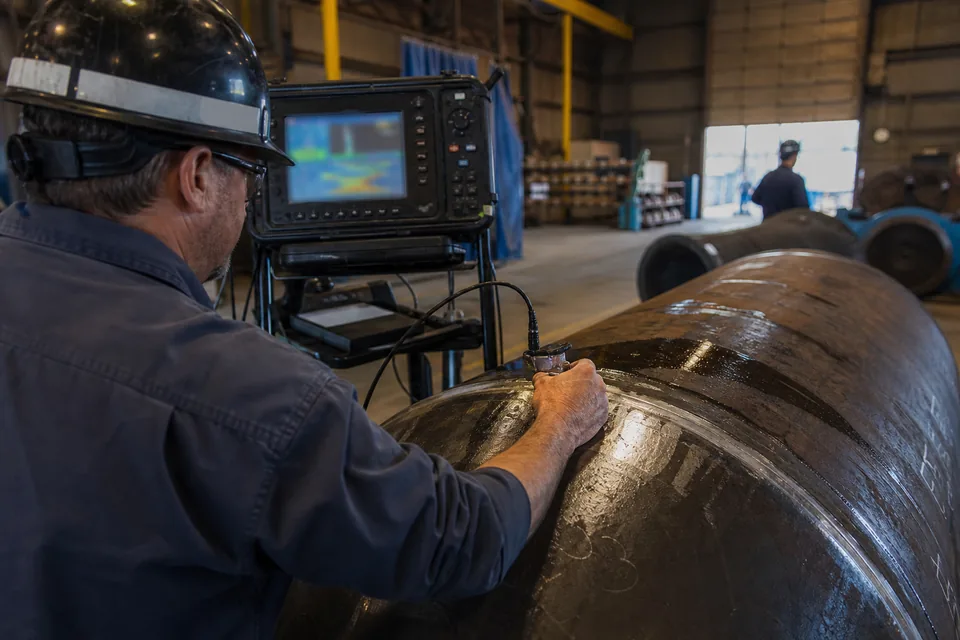
| UT thickness grid or corrosion mapping | $800 to $3,500 | Grid spacing, area covered, data delivered as a map |
| PAUT or TOFD on vessel welds | $1,500 to $6,000 | Weld length, wall thickness, code and acceptance criteria |
| Wet fluorescent MT or dye penetrant on welds | $600 to $2,000 | Surface preparation, coating removal, area |
| Corrosion under insulation checks | $1,500 to $6,000 | Number of insulation windows, profile radiography, pulsed eddy current |
| Radiography of repair welds | $60 to $250 per weld | Exclusion zone, views, retest rule |
| Mobilization and travel | $500 to $3,000 per trip | Mileage, hotel, per diem |
| Minimum charge | $500 to $1,500 | Half or full day |
For the method side of these jobs, see our pressure vessel inspection services page, which shows which technique finds which damage mechanism.
What drives pressure vessel inspection pricing
- Size and number of vessels. A 20 foot column takes longer to grid than an air receiver, but a campaign of ten similar vessels cuts the price per vessel because setup and travel are shared.
- Insulation. Insulated vessels need windows cut and reinstated, or pulsed eddy current and profile radiography, to look for corrosion under insulation.
- External or internal. An internal inspection needs the vessel emptied, cleaned, isolated and ventilated, then a permit for entry. That preparation is usually priced by the plant, not the inspector.
- Weld methods. Adding phased array or TOFD on seams, or MT on nozzle welds, moves a $2,000 external job into the $6,000 to $15,000 range.
- Inspector and code. API 510 work needs an authorized inspector. Jobs under ASME Section VIII repairs or in jurisdictions with a state inspector add reporting steps.
- Access. Scaffolding, rope access or a crane for tall vessels is often the largest line on the invoice.
- Remaining life calculations. A corrosion rate, remaining life and next inspection date in the report cost more than a list of readings.
Illustrative budgets with the scope added up
These examples show how the pieces combine. They are planning illustrations, not offers.
- One uninsulated air receiver, external thickness check and report. Roughly $1,200 to $2,500.
- A 10 foot insulated separator, external inspection with 8 insulation windows and a UT grid. Roughly $3,500 to $7,000 plus insulation work.
- A reactor opened at turnaround, internal visual, PAUT on three seams and MT on nozzle welds. Roughly $8,000 to $15,000, before cleaning and scaffolding.
- A set of six identical heat exchanger shells, external UT and report. Roughly $6,000 to $14,000 as one campaign, less per vessel than six separate callouts.
Costs that sit outside the inspection quote
- Cleaning, degassing and isolation, handled by the plant or a cleaning contractor.
- Scaffolding, rope access or a lift for access to shell and nozzles.
- Confined space entry, standby attendant and gas testing.
- Insulation removal and reinstatement, usually the surprise line on an external job.
- Coating repair after surface preparation for MT or PT.
- Downtime. A day offline on a process unit costs far more than the inspection, which is why many owners pay extra to run the job during a planned outage.
How to lower pressure vessel inspection cost without cutting coverage
Bundle vessels into one campaign and send the full list with design data, previous reports and insulation status. Use risk based inspection intervals so low risk vessels are not opened on a fixed schedule when the code allows longer. Check whether an external inspection with UT thickness data can replace an internal on a clean service, since API 510 allows it in some cases. Schedule NDT crews during a turnaround so scaffolding is shared. Teams that need to line up inspection cost against a yearly maintenance plan can do it with budget planning software before the outage is booked.
What to send for comparable pressure vessel inspection quotes
- Vessel list with tag numbers, size, service, design pressure and temperature, and year built.
- Previous inspection reports and last measured wall thickness, so corrosion rate can be calculated.
- Insulation, coating and access details, including height and scaffolding needs.
- External or internal scope, and which weld methods you want (PAUT, TOFD, MT, PT, RT).
- Code and jurisdiction, for example API 510, ASME Section VIII, and any state requirements.
- Site, working hours, permit rules and outage window.
- Report format, including remaining life and next inspection date.
- Price per vessel plus a not to exceed total, and the minimum charge and standby rule written out.
How much does a pressure vessel inspection cost?
A pressure vessel inspection in the US usually costs $1,200 to $5,000 for an external in service API 510 inspection and $3,000 to $15,000 for an internal inspection with weld NDT. Cleaning, scaffolding and entry permits are extra and can exceed the inspection price.
How often must a pressure vessel be inspected?
API 510 sets external inspections at least every five years and internal or on stream inspections at no more than half the remaining life or ten years, whichever is shorter. Risk based inspection can adjust the interval. Your jurisdiction and insurer may require shorter intervals.
Is an internal inspection always required?
No. An on stream inspection with UT thickness data can replace an internal inspection when the corrosion rate is low, the service is clean and the code allows it. Vessels with unknown damage mechanisms or high risk usually still need to be opened.
Who can perform an API 510 inspection?
An API 510 certified authorized inspector must lead the inspection and sign the report. NDT technicians qualified to ASNT Level II or III under the company written practice do the UT, MT, PT or radiography work and report to the inspector.
Does corrosion under insulation raise the cost?
Yes. Insulated vessels need windows cut and closed, or pulsed eddy current and profile radiography, which adds $1,500 to $6,000. The cost is justified on vessels in cyclic or wet service where corrosion under insulation is a common failure.