How a CT service bureau builds a price
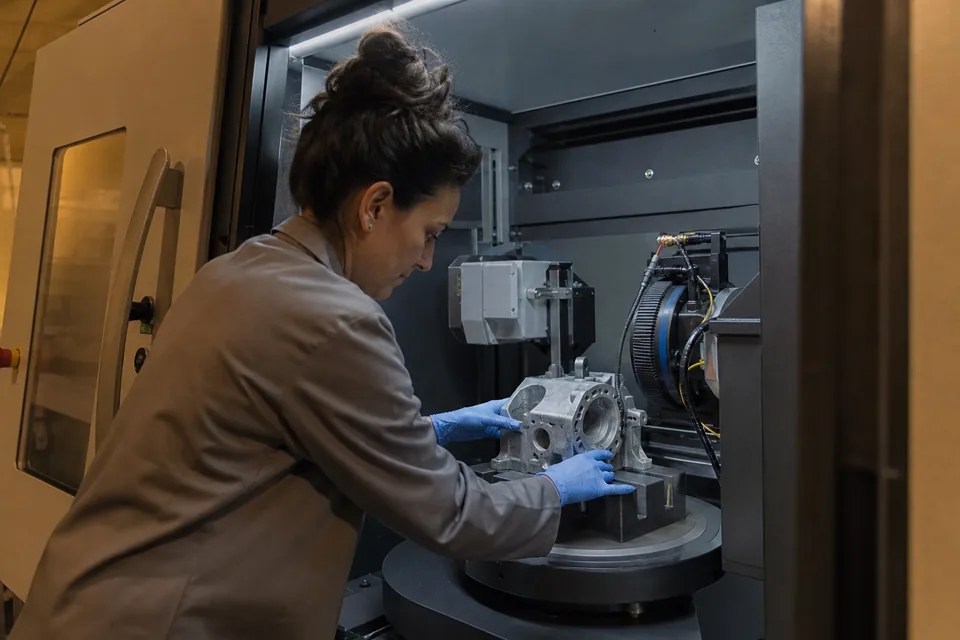
A CT system is an expensive instrument with a fixed hourly cost, whether it scans a small connector or a large engine casting. Labs usually price in one of three ways: per hour of machine and analyst time, per part with a setup fee, or per project for first article and failure analysis work. Whatever the format, the underlying math is the same.
- Machine time: scan duration multiplied by the number of scans, plus setup and fixturing
- Reconstruction time: computing the 3D volume, typically automated but longer for large data sets
- Analysis time: porosity analysis, wall thickness, nominal to actual comparison against CAD, measurements
- Reporting time: images, annotated slices, tables, acceptance decisions and data export
- Logistics: shipping, receiving inspection, return or disposal of parts
Why voxel size dominates the scan time
Voxel size is the edge length of one 3D pixel in the reconstructed volume. In a cone beam system the voxel size scales roughly with the field of view, so the finer the voxel you need, the smaller the region you can capture in one scan. A part that must be inspected at fine resolution across its full length needs several stacked or stitched scans, and each one adds machine time. Higher resolution also needs more projections and longer exposures to keep noise down. Halving the voxel size on the same region can easily double or triple the scan time.
The main cost drivers for industrial CT scanning
These factors explain most of the spread between quotes.
| Driver | Effect on cost | What you can do |
|---|---|---|
| Part size and envelope | Large parts need high power systems and longer scans | Scan only the region of interest if the full part is not needed |
| Material and wall thickness | Steel and thick sections need higher energy and more time than aluminum or plastics | State material and max thickness so the lab picks the right system |
| Required voxel size | Finer voxel means smaller field of view and more scans | Specify the smallest flaw you must detect, not the finest resolution available |
| Number of parts | Setup spreads over more parts, multi part fixtures cut time | Batch parts and ask for a per part price at your volume |
| Analysis type | Porosity, wall thickness and CAD comparison each add analyst hours | Ask only for the analyses that support a decision |
| Report format | A pass or fail table is cheaper than annotated slices for every pore | Agree on the report template in the RFQ |
| Data delivery | Raw volume files can be tens of gigabytes per scan | Decide if you need raw data, a viewer package or only images |
| Turnaround | Rush slots displace other work | Plan first article scans ahead of PPAP or launch dates |
Typical industrial CT scanning cost ranges
The figures below are typical ranges seen in the US market for service bureau work, not quotes. Your price depends on the system, the part and the lab, and some jobs fall well outside these bands.
| Job type | Typical range, not a quote | Notes |
|---|---|---|
| Small part, single scan, images only | $300 to $900 per part | Connectors, small castings, plastic parts |
| Medium casting, porosity analysis | $600 to $2,000 per part | Aluminum housings, brackets, valve bodies |
| Nominal to actual CAD comparison | $800 to $2,500 per part | Includes alignment and color deviation map |
| Large or dense part, high energy CT | $1,500 to $6,000 per part | Steel castings, large assemblies, multiple scans |
| Hourly rate, machine plus analyst | $175 to $400 per hour | Common for open scope or failure analysis |
| Production batch, automated recipe | $50 to $300 per part | After a recipe is proven, at volume |
Expect a minimum charge for small jobs, often equal to one to two hours of system time, and a one time setup or programming fee for production recipes.
How to reduce industrial CT scanning cost without losing the answer
Most savings come from writing a tighter scope, not from negotiating the rate.
- Define the decision first: accept or reject, locate a defect, validate a process or reverse engineer a part
- State the smallest critical feature or pore size; a lab can then choose a voxel size that detects it with margin instead of the finest possible
- Mark the region of interest on a drawing, such as sealing surfaces, bolt bosses or thin walls
- Group parts that share material and size so the lab can scan them in one fixture
- Ask for a porosity summary table with acceptance against your criteria rather than images of every pore
- Agree in advance whether you need raw volume data; storing and transferring it takes time
- Run CT on first articles and suspect lots, then use radiographic testing for routine acceptance if 2D is enough
When CT is worth the money
CT costs more per part than 2D radiography, so it pays when the extra information changes a decision. Typical cases are first article inspection of castings and additive parts, root cause on field failures, verifying internal channels and wall thickness, measuring porosity by volume percent and location, and inspecting sealed assemblies like battery CT scanning work. For a direct comparison on castings, see CT vs X-ray inspection for castings.
Three common CT budgeting scenarios
The scenarios below show how the drivers combine. All figures are typical ranges, not quotes.
- First article on a new aluminum die casting: one to three parts, porosity analysis in marked zones and a CAD comparison. Expect roughly $1,500 to $6,000 for the set, depending on part size and how many analyses you request.
- Failure analysis on a leaking valve body returned from the field: one part, open scope, several scans at different resolutions to trace the leak path. Labs usually bill hourly, and four to twelve hours of combined machine and analyst time is common.
- Production audit of a plastic connector: twenty parts per month on a proven recipe with automated pass or fail evaluation. After a setup fee, per part prices often fall toward the low end of the production band.
Production CT versus one off scans
A one off scan carries all of its setup, fixturing and analysis decisions on a single invoice. Production CT spreads those costs. Once the lab has a fixture, a scan recipe and an automated evaluation template, each additional part needs only machine time and a quick review. If you expect to scan the same part number every month, ask for two prices: the first article price and the recurring per part price at your forecast volume. The difference is often large enough to change whether CT is viable for routine acceptance or only for audits.
Turnaround and its effect on price
Standard turnaround at most service bureaus runs from several working days to two weeks, depending on backlog and analysis depth. Rush service usually carries a premium, often 25 to 100 percent, because the lab moves other customers' work. Scan time itself is rarely the bottleneck; analysis and reporting are. If you need fast answers, ask for a preliminary set of slices and a short summary first, followed by the full report on a normal schedule.
Data, storage and software costs
A single high resolution volume can exceed tens of gigabytes. Some labs charge for data transfer, long term storage or a viewer license so your team can open the volume. Others include a free viewer. Decide early whether your engineers will work with the raw volume or only with images and tables, because that choice affects both cost and how quickly you can act on the results.
What to include in a CT request for quote
A complete RFQ gets you comparable quotes and avoids a second round of questions.
- Part description, material, overall dimensions, weight and max wall thickness
- Quantity now and expected volume later
- Purpose: first article, production acceptance, failure analysis, metrology or reverse engineering
- Smallest feature or defect to detect, and acceptance criteria (for example a porosity class or a drawing note)
- Region of interest, with a marked drawing or CAD file if available
- Analyses required: porosity, inclusions, wall thickness, nominal to actual, dimensional measurements
- Report format, data deliverables and any customer specific template
- Required certifications as stated by the provider, such as ISO 17025 scope covering CT, or NADCAP for aerospace work
- Shipping arrangements and required turnaround
Questions to ask the CT lab
Before you award the job, check that the lab can actually deliver the resolution and analysis you asked for.
- Which system will scan the part, and what are its max part size, max energy and achievable voxel size for this part?
- How many scans will the part need at the requested resolution?
- How do you validate measurement uncertainty for dimensional work?
- Which software performs porosity and CAD comparison, and can you export to formats my team can open?
- Who reviews the results, and what NDT qualification do they hold?