Oil and gas inspection services for piping, vessels and tanks
Refineries, gas plants, terminals and pipeline operators inspect on a code driven schedule, and every turnaround window is short. Tell the method advisor what the asset is, what damage mechanism you expect and which code applies, and get a ranked list of methods plus a request for quote that inspection contractors can price without a week of emails.
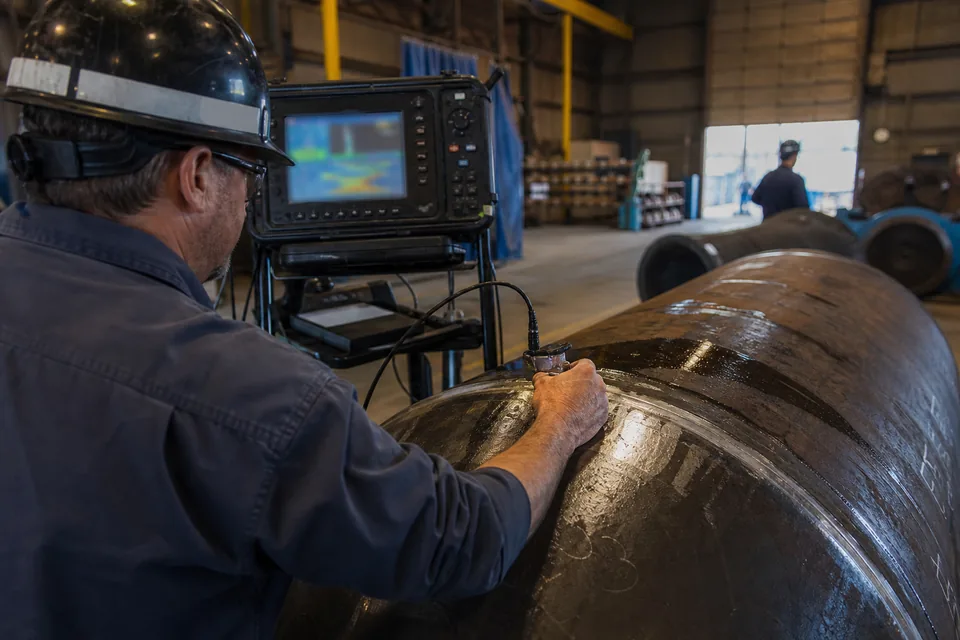
Which inspection method fits which oil and gas asset
| Asset | Methods most often used | Damage it targets |
|---|---|---|
| Process piping | UT thickness, radiographic testing profile shots, guided wave UT | General and localized corrosion, erosion, corrosion under insulation |
| Pressure vessels and exchangers | UT and PAUT, MT and PT, eddy current or IRIS on tubes | Wall loss, weld cracking, tube pitting |
| Aboveground storage tanks | MFL floor scanning, UT on shell and floor, visual | Underside floor pitting, shell thinning, settlement |
| New and repair welds | RT, PAUT, TOFD | Lack of fusion, porosity, slag, cracks |
| Flare stacks, tall structures | wind turbine drone inspection style aerial surveys, thermography | Tip damage, refractory loss, hot spots, coating failure |
| Pipelines | In line inspection, external UT and PAUT at digs | Metal loss, dents, cracking, weld anomalies |
| Electrical and rotating equipment | infrared inspection, borescope | Loose connections, overheating, internal wear |
For buried and long distance lines, start with our page on pipeline inspection companies.
What oil and gas NDT does well
- Maps remaining wall thickness so the inspector can calculate corrosion rate and remaining life.
- Finds planar weld flaws with phased array and TOFD without the radiation exclusion zone that RT needs.
- Screens long runs of insulated piping with guided wave before anyone strips insulation.
- Scans tank floors from above with MFL to find underside corrosion.
- Gets eyes on flare tips and high structures from a drone while the unit stays online.
Where oil and gas inspection has blind spots
- Spot UT readings can miss localized pitting between grid points; scanning or automated UT covers more area.
- Guided wave is a screening tool, so its calls need follow up with UT or RT at the indicated locations.
- RT needs access to both sides and a cleared area, which can conflict with other work during a turnaround.
- MFL loses sensitivity near tank walls and on thick coatings, so the critical zone often needs UT as well.
- High temperature service limits couplant and probe choice, and some techniques need special high temperature equipment.
Oil and gas inspection codes and certifications to name in the RFQ
- API 510 for pressure vessel inspection, API 570 for piping and API 653 for aboveground storage tanks. Ask whether the contractor provides the API authorized inspector or only the NDT technicians.
- ASME Section V for NDE methods, with ASME Section VIII and ASME B31.3 setting acceptance for new construction and repairs.
- API 1104 for pipeline welding and its NDT acceptance.
- ASNT SNT-TC-1A or ANSI/ASNT CP-189 for technician qualification, and API QUTE or QUPA for UT thickness and phased array where the owner requires them.
- Radiation safety and licensing for RT crews, plus the site safety orientations your plant requires.
Providers state their codes, personnel levels and qualifications on their profiles. Confirm current cards and certificates before mobilization.
Typical cost of oil and gas inspection services
Ranges below are typical estimates for US work, not a quote. Mobilization, site access, shift length and reporting format change the final figure.
| Job | Typical range, not a quote |
|---|---|
| UT thickness survey, one technician | $900 to $1,800 per day |
| PAUT or TOFD weld inspection | $1,500 to $3,000 per day |
| RT crew with source and darkroom or DR | $1,800 to $3,500 per day |
| Guided wave screening of piping | $2,500 to $5,000 per day |
| Tank floor MFL with UT follow up | $4,000 to $15,000 per tank |
| Drone survey of a flare stack or tall structure | $2,500 to $8,000 per job |
Night shifts, standby time during permits, travel, per diem and rush data packages add to these numbers. Ask each contractor to break them out so the quotes compare like for like.
How to write an oil and gas inspection RFQ contractors can price
- 01Asset list with line numbers, vessel or tank tags, sizes, materials and service.
- 02Damage mechanisms you expect (such as CUI, sulfidation, HTHA, microbiologically influenced corrosion) or the inspection plan reference.
- 03Code and owner requirements: API 510, 570 or 653, owner specifications, required technician qualifications.
- 04Access: insulation removal, scaffolding, rope access, confined space, operating temperature.
- 05Schedule: turnaround dates, shift pattern, whether the unit is online.
- 06Deliverables: thickness grids, corrosion rate tables, weld reports, data files and the format your inspection database accepts.
The advisor collects these fields in a fixed structure, so every contractor answers the same question. Learn how to get NDT quotes step by step.
FAQ
What is the difference between API 510, API 570 and API 653?
API 510 covers in service inspection of pressure vessels, API 570 covers piping systems and API 653 covers aboveground storage tanks, each with its own inspector certification.
Can inspection run while the unit is online?
Much of it can: UT thickness, guided wave, thermography, drone surveys and many PAUT jobs run online, while internal vessel inspection and some RT wait for a turnaround.
Is PAUT accepted instead of radiography for welds?
Many owners and ASME Section VIII and B31.3 allow ultrasonic examination in place of radiography when the procedure is qualified, so state your code edition and owner rules in the RFQ.
How do I compare quotes from different crews?
Ask for the same breakdown from each one: day rate, mobilization, equipment, consumables, standby, reporting and travel; the RFQ format makes that easier.
Do you supply the API inspector?
No, IndustrialImaging connects you with providers; some offer API certified inspectors and NDT crews, others only NDT, and their profiles state which.
Find oil and gas inspection contractors by method and region
IndustrialImaging ranks the methods that fit your asset and damage mechanism, explains the trade offs and turns your answers into an RFQ. After you create your account and confirm your email, the request goes to matched providers by method, state and certification. You compare their replies side by side and contract directly with the one you choose. Buyers use the platform at no cost.
- 01What needs inspecting
- ...
- 02Material
- ...
- 04Concern
- ...
Run an oil and gas inspection company? List your company
Publish your methods, API and ASNT qualifications and the states you cover, and receive structured requests from plant and pipeline buyers. Plans are listed on the pricing page.