Battery CT scanning and X-ray inspection for electronics
Cells and circuit boards fail from defects you cannot see from outside: misaligned electrodes, a stray particle, a voided solder ball, a cracked pin. CT and X-ray show them without cutting the part open. Describe the cell or assembly in the method advisor, get the method that fits your question, and send a request for quote to labs that list the resolution and part envelope you need.
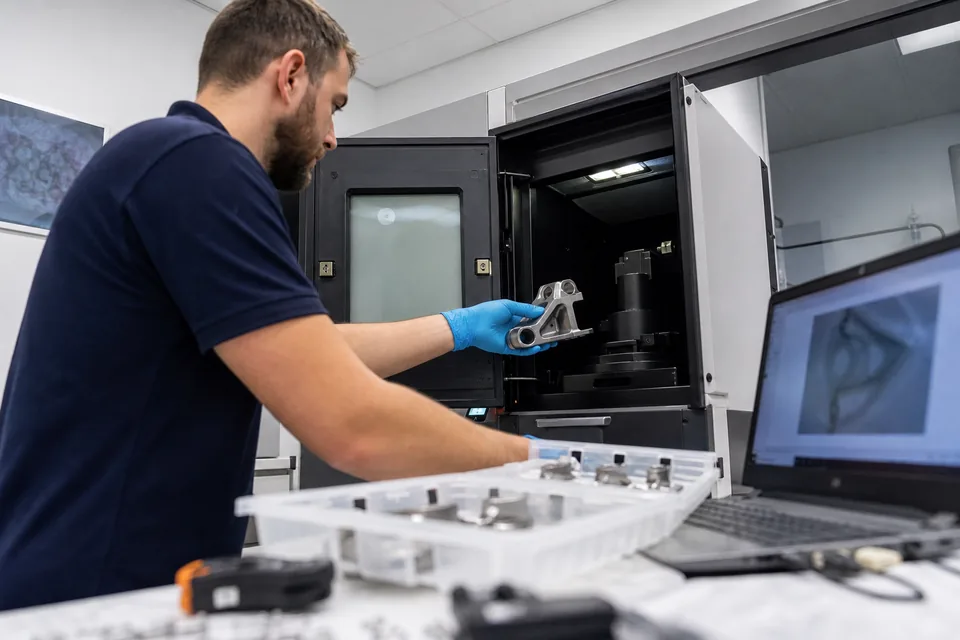
Battery and electronics inspection, matched to the question you are asking
| Part | Question | Method that usually answers it |
|---|---|---|
| Cylindrical cells (18650, 21700, 4680) | Electrode overhang, jelly roll deformation, tab welds, can defects | Industrial CT scanning at high resolution |
| Pouch and prismatic cells | Layer alignment, folds, wrinkles, swelling, foreign particles | CT with region of interest scans, 2D X-ray for screening |
| Battery modules and packs | Busbar welds, cell placement, cooling channel position | CT for subassemblies, 2D X-ray for large packs |
| BGA, QFN and LGA packages | Solder voids, bridges, head in pillow, missing balls | 2D X-ray with oblique views, CT or laminography |
| Through hole and press fit connectors | Barrel fill, pin damage, cracked housings | 2D X-ray, CT of the connector |
| Bare boards and assemblies | Via defects, internal shorts, delamination | X-ray, CT, acoustic microscopy for delamination |
2D radiographic testing is faster and cheaper; CT gives the third dimension that root cause work often needs.
What battery cell CT inspection shows
- Anode to cathode overhang at the edges, measured layer by layer around the full circumference of a cylindrical cell.
- Electrode misalignment, folds and wrinkles in stacked or wound designs.
- Foreign particles and contamination inside the cell, down to the scan resolution.
- Tab and weld quality, can and lid weld defects, and crimp geometry.
- Deformation, gas pockets and swelling after cycling or abuse testing.
What cell CT does not show
- Chemistry, electrolyte state and lithium plating at the microscopic level usually need teardown and lab analysis.
- Features smaller than about two to three voxels; a full cell scan at moderate resolution can miss small particles that a region of interest scan finds.
- Electrical behavior; CT complements electrical and thermal testing, it does not replace it.
PCB, solder joint, BGA and connector inspection
X-ray is the standard way to inspect hidden solder joints under area array packages. A lab with oblique angle views and CT can measure void percentage per ball, find head in pillow defects and check barrel fill on through hole parts. Connectors and cable assemblies are scanned to look at pin seating, crimp quality and internal cracks after a field return. For failure analysis, CT lets an engineer slice through a board in software before deciding where to cross section.
- Void measurement per ball or joint against your acceptance criteria.
- Detection of bridges, opens and missing or misregistered balls.
- Inspection of crimps, wire bonds in power modules and press fit pins.
- Counterfeit screening by comparing die and lead frame to a known good part.
Standards and context for electronics and battery inspection
- IPC-A-610 for acceptability of electronic assemblies, the reference most buyers use when judging solder joints.
- IPC-7095 for BGA design and assembly, including void classification guidance.
- J-STD-001 for soldering requirements.
- ASTM E1570 practice for CT examination, and ISO/IEC 17025 accreditation when results must be traceable.
- Battery programs set their own CT criteria for overhang, alignment and particles, often in the customer specification or cell design documents; state them in the RFQ.
Labs state their accreditations on their profiles, so confirm the scope for your part type before shipping.
Typical cost of battery CT scanning and electronics X-ray
Typical estimate bands for US labs, not a quote. Resolution, number of scans per part and analysis depth decide the price.
| Job | Typical range, not a quote |
|---|---|
| 2D X-ray of a PCB assembly | $50 to $250 per board |
| CT of a BGA region or connector | $300 to $1,200 per part |
| CT of a cylindrical cell with overhang analysis | $300 to $1,500 per cell |
| CT of a pouch or prismatic cell | $800 to $3,000 per cell |
| Failure analysis package with CT and report | $1,500 to $5,000 per case |
Shipping lithium cells has its own rules for packaging and labeling, so ask the lab how they want cells sent and whether they accept damaged cells.
What to write in a battery or electronics inspection RFQ
- 01Part type and size: cell format, pack or module dimensions, board size and component count.
- 02The question: overhang check, particle search, void percentage, root cause of a field failure.
- 03Required resolution or smallest feature, and the zones of interest.
- 04Quantity: one failed part, a statistical lot, or recurring production checks.
- 05Cell state of charge and condition (new, cycled, swollen, damaged).
- 06Deliverables: images, measurements, CT volume file, report against IPC or your criteria.
Read how to get NDT quotes for the full process.
FAQ
Can CT scan a battery cell without opening it?
Yes, that is the main reason to use CT; the cell stays sealed, which also lets you scan before and after cycling.
What resolution do I need for electrode overhang?
It depends on the cell, but overhang checks typically need voxel sizes of a few tens of microns or finer in the edge regions; the lab will propose a setup.
Is X-ray enough for BGA voids?
2D X-ray is usually enough for void percentage on standard BGAs; CT or laminography helps when parts are mounted on both sides of the board.
Can a damaged or swollen cell be scanned?
Some labs accept damaged cells with extra safety controls, others do not; say so in the RFQ so only labs that handle them reply.
Find a lab for cell CT or PCB X-ray
The method advisor ranks 2D X-ray, CT and other options for your part, lists what each one cannot answer and shows a typical turnaround and price band labeled as an estimate. After you create your account and confirm your email, your RFQ goes to matched labs by method, envelope and resolution. Images and drawings stay private, see inspection data security.
- 01What needs inspecting
- ...
- 02Material
- ...
- 04Concern
- ...
Offer battery CT or electronics X-ray? List your company
List your systems, voxel size, part envelope and cell handling capability to receive matched electronics and battery requests. See plans on pricing.