Pipeline inspection companies for every kind of line
Choosing between pipeline inspection companies starts with the pipe, not the vendor. A 24 inch gas transmission line with launchers, an unpiggable plant line full of bends and a municipal sewer each need a different tool. Describe your line, and we help you pick the inspection approach, then send one structured RFQ to providers who run that technology.
Pipeline inspection technologies in one view
| Approach | What it covers | Typical use |
|---|---|---|
| In line inspection (smart pigs) | Full length, from inside | Piggable transmission and gathering lines |
| Robotic crawlers and tethered tools | Full length from inside, short to medium runs | Unpiggable lines, plant piping, low flow lines |
| Guided wave UT | Screening tens of feet from one location | Road crossings, insulated and buried sections, pipe racks |
| Conventional and phased array UT | Local wall thickness and weld quality | Spot checks, verification digs, welds |
| CCTV and pipeline video inspection | Visual of the inside | Sewers, storm drains, water and process lines |
| External surveys and ECDA | Coating and cathodic protection from above ground | Buried lines where internal tools do not fit |
In line inspection tools
In line inspection tools travel inside the pipe with the product flow, launched and received through pig traps. Magnetic flux leakage (MFL) tools saturate the wall with a magnetic field and detect metal loss from internal and external corrosion; axial MFL is the common workhorse, and circumferential designs respond better to narrow axial features. Ultrasonic wall measurement tools give direct thickness readings in liquid lines, ultrasonic and EMAT crack tools target stress corrosion cracking and seam defects, and caliper or geometry tools find dents, ovality and restrictions. Inertial mapping units add location and bending strain. Before a high resolution run, operators usually run cleaning pigs and a gauging or caliper tool to confirm the tool can pass.
- Metal loss from corrosion, internal and external
- Dents, ovality and geometry restrictions
- Cracks and crack like features, with crack detection tools
- Pipeline route and bending strain, with inertial mapping
Robotic pipeline inspection for unpiggable lines
Many lines were never built for pigs: tight bends, changes in diameter, plug valves, no launchers, or flow too low to push a tool. Robotic crawlers and tethered or self propelled tools carry ultrasonic, MFL, eddy current or laser and camera sensors through these lines, often from a single access point. Runs are shorter and slower than free swimming ILI, but they reach plant piping, station piping and short critical segments that otherwise get only spot checks.
Guided wave and UT
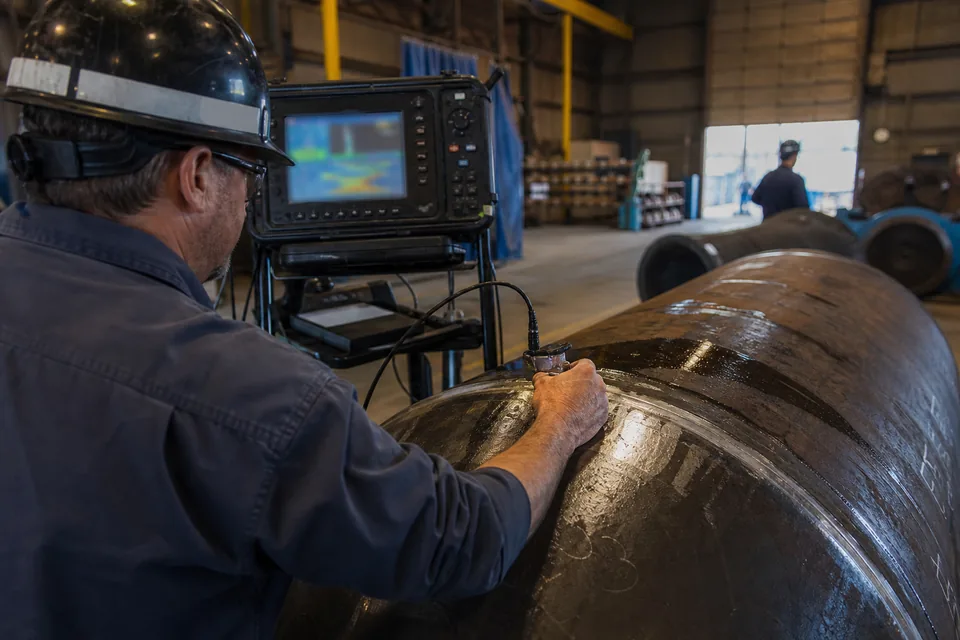
Guided wave ultrasonic testing sends low frequency waves along the pipe wall from a ring of transducers clamped at one location and screens for changes in cross section, often tens of feet in each direction depending on coating, soil, fluid and features. It is a screening tool: it tells you where to look, and flagged areas are then measured with conventional or phased array ultrasonic testing. It is widely used at road crossings, wall penetrations, insulated lines and pipe racks. For welds in new construction, radiographic testing and automated UT remain standard.
Pipeline video inspection with CCTV
For sewers, storm drains, water mains and process drains, a camera on a crawler or push rod records the inside of the pipe. Operators code what they see, such as cracks, root intrusion, offsets, deformation, deposits and infiltration, and many municipal programs require coding to the NASSCO PACP standard. CCTV shows the visible surface only; for wall loss in pressure pipe, a sensor based tool is needed.
External surveys and ECDA
Buried steel lines can also be assessed from the surface. External corrosion direct assessment (ECDA) follows a four step process (pre assessment, indirect inspection, direct examination at dig sites, post assessment) using surveys such as close interval potential surveys, DCVG and ACVG to find coating holidays and cathodic protection problems. Leak surveys, right of way patrols and drone or aerial surveys add surface and encroachment data, see drone inspection services.
PHMSA context, stated carefully
Gas transmission and hazardous liquid pipelines in the United States are regulated by PHMSA under 49 CFR Parts 192 and 195, which include integrity management requirements for segments that could affect high consequence areas. Assessment methods recognized there include in line inspection, pressure testing and direct assessment, among others. Which method and interval apply to your line is a matter for your integrity management program and your compliance team; an inspection provider supplies data and reports, not regulatory sign off.
What pipeline inspection finds
- Internal and external metal loss, pitting and general corrosion
- Dents, buckles, ovality and restrictions
- Crack like features with crack specific tools
- Coating defects and cathodic protection shortfalls from above ground surveys
- Blockages, deformation and joint defects in gravity pipe with CCTV
What it can miss
- Features below a tool's detection threshold or in its blind zones
- Narrow axial features with standard axial MFL, which is why tool choice matters
- Anything beyond a guided wave screening range or masked by heavy coatings and supports
- Wall loss behind deposits in a CCTV survey
How to choose pipeline inspection companies
- Match the tool to the threat: metal loss, cracks, dents or coating condition
- Ask for tool specifications: probability of detection, sizing accuracy and confidence for each feature type
- Check whether the provider qualifies tools and analysis under API 1163 and personnel under ANSI/ASNT ILI-PQ
- Ask about run success history on lines like yours, cleaning and gauging requirements, and rerun terms
- Look at the deliverable: feature list format, dig sheets, integration with previous runs
- For CCTV, ask for PACP certified operators and coded reports
- Confirm safety programs, operator qualification for covered tasks and insurance
Typical price bands for pipeline inspection
Cost depends on line length and diameter, tool technology, number of runs, cleaning and gauging runs, mobilization, analysis level and field support.
| Job | Typical range, not a quote |
|---|---|
| ILI run on a piggable segment, including analysis | $30,000 to $250,000 or more |
| Robotic crawler inspection, short critical segment | $15,000 to $80,000 |
| Guided wave UT, crew day | $2,500 to $6,000 per day |
| Close interval survey | $1,000 to $3,500 per mile |
| Sewer CCTV with coded report | $1 to $5 per foot |
See oil and gas inspection services and NDT inspection cost for context.
What to put in a pipeline inspection request
- 01Product, diameter, wall thickness, length, grade and age
- 02Launchers and receivers, bends, valves, diameter changes and known restrictions
- 03Operating pressure, flow and whether the line can be taken out of service
- 04Threats you need to assess and previous inspection history
- 05Deliverables, data format and compliance deadline
FAQ
What makes a pipeline unpiggable?
Missing launchers and receivers, tight bends, diameter changes, certain valves or low flow can stop a free swimming tool, and robotic or tethered tools are the usual answer.
Is guided wave testing a replacement for ILI?
No, guided wave screens a limited length from one location and flags areas for follow up, while ILI measures the whole line.
How long does an ILI project take?
Planning, cleaning and the run often take weeks, and the final report usually follows within roughly 30 to 90 days, with preliminary results for critical features earlier.
Can CCTV find corrosion in pressure pipe?
It shows visible internal corrosion and deposits, but it cannot measure remaining wall, which needs a sensor based tool.
Do pipeline inspection companies handle compliance?
They provide data and reports, while the pipeline operator remains responsible for integrity decisions and regulatory compliance.
One request to matched providers
The advisor reads your line description and ranks the approaches with reasons, limits, typical turnaround and a typical price band labeled as an estimate, then writes a structured RFQ. After you create your account and confirm your email, the request goes to providers matched by technology, region and stated qualification. Buyers never pay. See how to get NDT quotes for the full process.
- 01What needs inspecting
- ...
- 02Material
- ...
- 04Concern
- ...
Run a pipeline inspection service? List your company
Show your tools, diameter range, technologies and regions, and receive structured requests with line data already filled in. See plans and pricing.