Storage tank inspection services for API 653 and tank floors
Storage tank inspection services check the floor, shell, roof, nozzles and foundation of an aboveground tank against API 653 so you know whether it can stay in service. An API 653 authorized inspector leads the job, and NDT crews supply the method work: magnetic flux leakage (MFL) floor scanning, ultrasonic shell and floor thickness, magnetic particle or penetrant testing at weld repairs, and vacuum box leak tests. In the US an external in service inspection typically costs $2,500 to $9,000 per tank and an out of service internal inspection with floor scan $8,000 to $40,000, before cleaning.
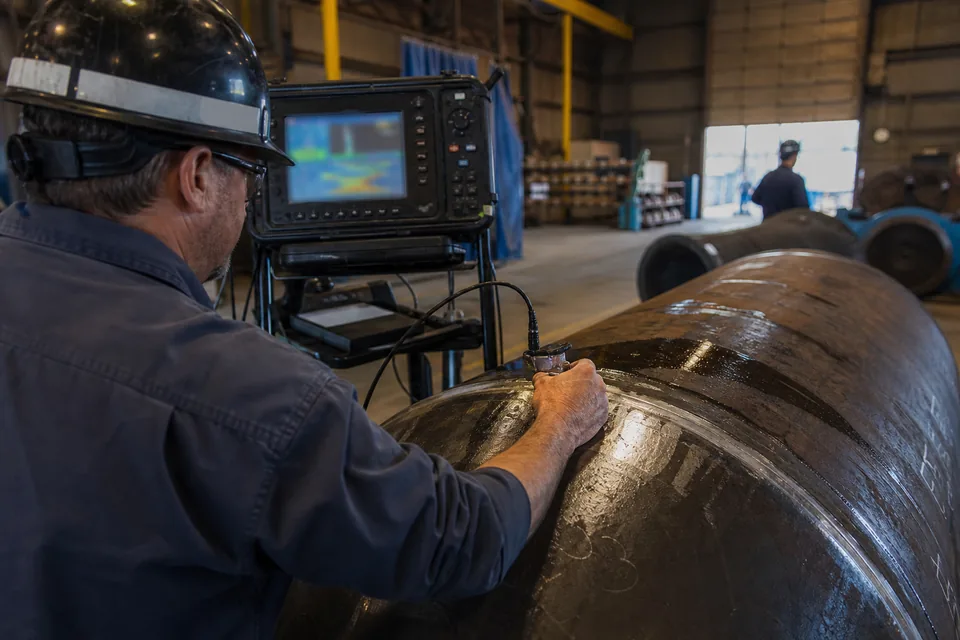
Which method inspects which part of a storage tank
| Tank part | Method | What it finds | Typical US range per tank |
|---|---|---|---|
| Shell courses | UT thickness grid, automated crawler scan | General wall loss, pitting, corrosion at the product line | $1,500 to $6,000 |
| Shell welds | Visual, magnetic particle, PAUT on repairs | Cracks, undercut, lack of fusion at seams and repairs | $1,200 to $4,000 |
| Floor plates, out of service | MFL floor scan with UT follow up | Underside corrosion, pitting, soil side attack | $3,500 to $18,000 |
| Floor, in service | Acoustic emission screening | Active corrosion and leaks, ranks tanks for opening | $4,000 to $12,000 |
| Floor weld seams | Vacuum box test | Through seam leaks | $800 to $3,000 |
| Roof and roof structure | Visual, UT thickness, drone survey of floating roofs | Thin plate, ponding damage, seal wear, pontoon leaks | $800 to $3,500 |
| Nozzles and manways | UT thickness, PT, MT | Corrosion at the neck, cracks at the weld | $600 to $2,500 |
| Foundation and ringwall | Visual survey, settlement survey | Edge settlement, cracks, water under the chime | $800 to $3,000 |
These are planning ranges, not quotes. Tank diameter, height, product, access and the report you need change the real price, and several tanks at one site cost less per tank than a single call out.
API 653 sets who inspects and how often
API 653 covers the inspection, repair and alteration of aboveground steel storage tanks built to API 650 or API 12C. The tank owner or operator must have an authorized inspector (API 653 certified) sign off the records. The standard asks for routine in service checks by the owner, a formal external inspection at set intervals, and an internal inspection when the floor corrosion rate and the remaining thickness say it is due. The interval depends on measured corrosion rates, product and risk based inspection (RBI) results, so the thickness data you buy now decides how long you wait for the next internal. Ask the contractor to state which API 653 clause each scope item answers, and have the final report show remaining life by component.
Tank floor inspection, the line item that decides the budget
Most of the cost and most of the risk sit in the floor, because the underside corrodes where nobody can see it. An out of service MFL scan covers the plates between the weld seams, flags thinned areas and pits, and the crew confirms the worst indications with UT. Edge zones near the shell, where scanners cannot reach, get hand UT. The result is a minimum remaining thickness and a map you can use to plan patch repairs or a new bottom. When opening the tank is hard to justify, acoustic emission screening ranks tanks by activity so the budget goes where the corrosion is. For the method background see ultrasonic testing services and magnetic particle inspection.
Shell and roof thickness without taking the tank offline
Shell thickness can be measured in service. Rope access or lift crews take UT readings on a grid, and crawler scanners cover whole courses faster with a record of every point. Weld seams and repair patches are checked with PAUT or magnetic particle testing. Floating roofs and tall shells are often screened first by drone, which cuts the time crews spend at height. The drone inspection services page shows what an aerial survey sees and what still needs contact methods. Girth welds on attached piping are covered under pipe weld testing.
Who buys storage tank inspection
Terminal and refinery reliability engineers buy API 653 inspections on a schedule set by their RBI program. Chemical plants order them before a change of service and after a leak or a settlement event. Fuel distributors and airports need them for regulatory and insurance records. Water, ethanol and biodiesel operators use them before extending a tank life or selling a site. Buyers of a terminal order a baseline inspection of every tank during due diligence. Engineering firms hire the NDT crew on behalf of an owner who has an outage window.
How a storage tank inspection job runs
- You send tank number, diameter, height, product, year built, last inspection date and what the last report found.
- The inspection company proposes a plan: in service or out of service, methods, crew and access. For out of service work, the tank must be emptied, cleaned and gas free before anyone enters.
- Crews mobilize, complete site safety and permit steps and inspect in the agreed window. Confined space entry needs a permit, an attendant and rescue plan.
- Data is reviewed by a qualified technician and the API 653 inspector, who assigns remaining life and repair priorities.
- You receive a report with thickness maps, floor scan results, defect list, corrosion rates, a recommended interval and repair recommendations. Urgent findings are called in the same day.
What storage tank inspection costs
Cleaning and downtime often cost more than the inspection itself. Ask whether the quote includes them.
- External in service API 653 inspection. $2,500 to $9,000 per tank, depending on size and the number of thickness points.
- Out of service internal inspection with MFL floor scan. $8,000 to $40,000 per tank, plus cleaning, scaffolding and vapor control.
- Tank cleaning before entry. Often $10,000 to $100,000 or more for large crude or heavy product tanks, quoted by the cleaning contractor.
- Acoustic emission floor screening. $4,000 to $12,000 per tank.
- Vacuum box testing of repair welds. $800 to $3,000.
- Drone survey of a floating roof. $800 to $3,500 per tank.
- Mobilization and travel. $500 to $3,000 per trip for remote terminals.
Standby time during permits, night shifts and rush reports add to these numbers. Ask each contractor to list them separately so quotes compare like for like. The NDT inspection cost guide shows how crews price the underlying methods.
What to put in your storage tank inspection RFQ
- 01Site, number of tanks and a tank data sheet for each: diameter, height, shell material, year built, product and specific gravity.
- 02Scope per tank: external only, or internal with floor scan, shell UT, roof and nozzles.
- 03Code and edition: API 653, API 650 and any owner standard or jurisdiction rule.
- 04Date and findings of the last inspection, known leaks and previous repairs.
- 05Floor type: single bottom, double bottom, release prevention barrier or coating.
- 06Deliverables, such as thickness maps, floor scan plots, remaining life and a repair list in a spreadsheet.
- 07Window, who prepares the tank and who supplies scaffolding, power and gas testing.
- 08Qualifications required: API 653 authorized inspector, ASNT Level II for each method, and the insurance limits.
How to choose a storage tank inspection company
Check that the lead is an API 653 authorized inspector and that the MFL, UT and PAUT technicians hold ASNT SNT-TC-1A or CP-189 Level II certification. Ask for a sample floor scan report on a tank like yours and how they cover edge zones. Confirm the confined space program and injury record, insurance, and how quickly the first data is delivered after the crew leaves site. Quote comparisons only work when the scope, the code edition and the minimum thickness assumptions are the same in every response.
FAQ
How much do storage tank inspection services cost?
Storage tank inspection services in the US usually cost $2,500 to $9,000 per tank for an external in service inspection and $8,000 to $40,000 for an out of service internal inspection with floor scan. Cleaning, scaffolding and downtime are billed separately and can exceed the inspection itself.
How often must an aboveground storage tank be inspected under API 653?
API 653 sets a routine owner check, a formal external inspection at regular intervals and an internal inspection when the floor condition and corrosion rate say it is due. The exact interval comes from measured thickness, product and your risk based inspection program, so the authorized inspector sets it in the report.
What is MFL tank floor inspection?
Magnetic flux leakage floor inspection runs a scanner over the tank bottom plates and detects thinning and pitting from the magnetic field it disturbs. The crew confirms the worst indications with ultrasonic thickness readings. It needs the tank emptied and cleaned, and it does not cover the edge zone beside the shell.
Can a storage tank be inspected while in service?
Yes, in part. Shell thickness, external welds, roof and nozzles can be inspected in service, and acoustic emission screening gives a read on the floor. A full floor scan and internal visual need the tank emptied, cleaned and gas free first.
Who can perform an API 653 inspection?
An API 653 certified authorized inspector must lead and sign the inspection. NDT technicians qualified to ASNT SNT-TC-1A or CP-189 do the method work such as UT, MT and MFL under that inspector. Many terminals buy both from one contractor or hire the inspector and the crew separately.
Get matched with storage tank inspection companies
Describe the tanks in the inspection method advisor, with diameter, product and inspection history. It picks the methods that answer your question, builds a complete request for quote and sends it to NDT companies that list those methods and cover your state. You compare quotes on the same scope instead of repeating the job description to each vendor.
- 01What needs inspecting
- ...
- 02Material
- ...
- 04Concern
- ...
Run an inspection company that serves tank terminals? List your company
Show your MFL, UT, PAUT and acoustic emission capability, your API 653 inspectors and the states you cover, and receive matched storage tank inspection RFQs. Learn more for providers.