Acoustic emission testing services for vessels and tanks
IndustrialImaging matches your acoustic emission job to NDT companies that run AE crews in your region. Acoustic emission testing services listen to a whole vessel, tank floor or aerial boom while it is loaded, and they locate the cracks, corrosion and leaks that are active right now. Owners buy AE when they need a screening of a large asset without opening it, and then send UT or other methods only to the zones AE flags.
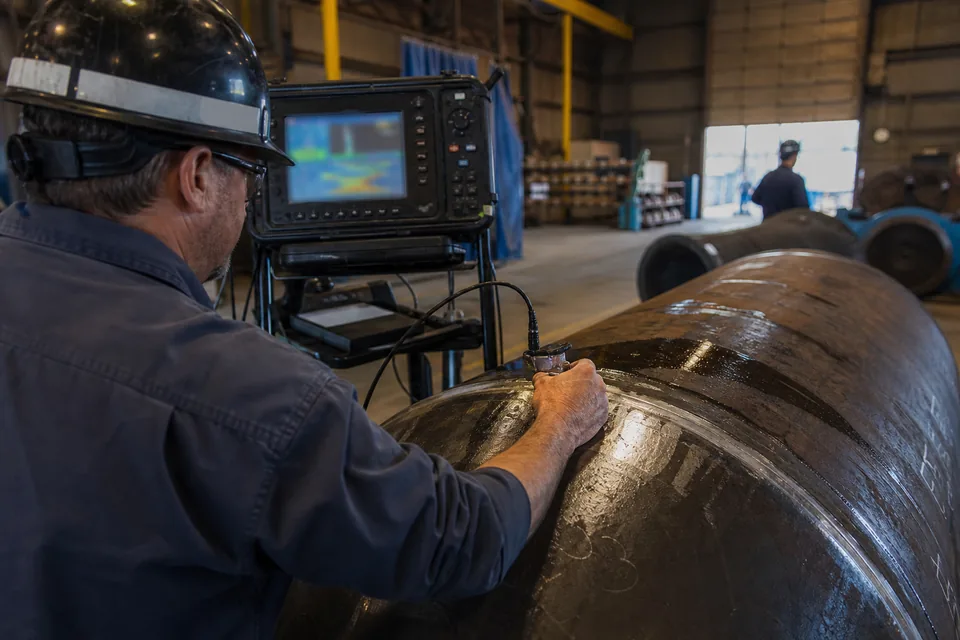
What acoustic emission testing covers
| Asset | How it is loaded | What AE reports | Usual follow up |
|---|---|---|---|
| Metal pressure vessels and spheres | Controlled pressure rise, often during the hydrotest or a requalification test | Located sources graded by activity and intensity | UT, MT or PT on the graded zones |
| FRP vessels and tanks | Fill or pressure to a set load in stages | Fiber breakage, delamination and resin cracking by zone | Visual and UT on flagged areas |
| Aboveground storage tank floors | Tank in service, product at rest, settled fill level | Floor zones graded for active corrosion and leaks | MFL floor scan or internal inspection planning |
| Aerial devices and bucket trucks | Boom loaded to a test load in set positions | Sources on the boom, pins and welds | Repair, MT on welds, retest |
| Piping, valves and process lines | Pressure or thermal load in service | Active leaks and crack growth in a section | Spot UT, PAUT or a planned repair |
AE does not measure wall thickness or size a flaw. It tells you where something is active and how severe the activity is, so the next method goes to the right place. For the methods that size flaws, see ultrasonic testing services and phased array ultrasonic testing services.
Codes and standards acoustic emission testing runs under
The governing document decides the load schedule, sensor spacing and grading criteria, so name it in the request. Pressure vessel work in the US usually follows ASME Section V, Article 12 for metal vessels during pressure testing and Article 11 for fiber reinforced plastic vessels, both published by ASME. Aerial devices are tested to the procedure the device standard and the owner program call for, typically an ASTM acoustic emission method for insulated booms. Tank floor screening is a risk based tool that sits alongside an API 653 program, not a replacement for the internal inspection the standard sets.
Personnel are usually qualified to ASNT SNT-TC-1A or ANSI/ASNT CP-189 for the AE method. Ask for the Level II or Level III who signs the report.
Who buys acoustic emission testing services
- Refinery and chemical plant reliability engineers who must requalify vessels or spheres and want a full volume screening during the pressure test.
- Tank owners who need to rank many tanks by floor condition before scheduling which ones come out of service first.
- Electric utilities and tree care fleets that must test insulated aerial devices and bucket trucks on a set interval.
- Operators of FRP tanks and scrubbers in chemical and water treatment service who need a structural check without draining and entering.
- Plant owners who see a leak or a crack indication and want to know if it is growing.
- Equipment owners who must test vessels that cannot be opened easily, such as lined or insulated vessels.
Who acoustic emission testing is for
It fits large assets where opening, cleaning or scanning every square foot costs more than a screening, and where you can apply a controlled load. It is not the right buy when you need a thickness survey, a flaw size for a fitness for service calculation or a code required volumetric weld test. Then order ultrasonic thickness testing services or hydrostatic testing services for the pressure test itself, and use AE alongside them.
How an acoustic emission testing job runs
- You send the asset list, sizes, materials, design pressure or test load, the governing code and the schedule.
- The provider plans the sensor layout and the load schedule and confirms who supplies the pressure source or test load.
- The crew mounts sensors, checks sensitivity with a pencil lead break at each sensor and records background noise.
- The load is applied in steps with holds, and the system records and locates emission sources.
- The Level II or Level III grades each source against the procedure criteria and marks zones for follow up.
- You receive a report with sensor map, load record, graded sources and recommended follow up methods.
What drives the price of acoustic emission testing
- Asset size and sensor count. A large sphere or tank floor takes many more channels than a small vessel.
- Load source. Who supplies the pressure pump, water or test weights, and whether the test rides on a hydrotest you already planned.
- Background noise. Pumps, flow and wind can force night work or longer holds.
- Mobilization and access. Sensor mounting on insulated or elevated assets needs insulation windows or lift access.
- Report and follow up. Grading, sensor maps and the follow up UT or MT on flagged zones add lines.
Pairing AE with a planned pressure test usually cuts the extra cost, because the load is already there. For rates across methods see NDT inspection cost and the vessel budget in pressure vessel inspection cost.
What to put in your acoustic emission testing request for quote
- 01Asset type, dimensions, material and any lining or insulation.
- 02Design pressure, test pressure or test load and who supplies it.
- 03The code or procedure to follow and the grading criteria.
- 04Whether the test runs during a planned hydrotest or as a standalone test.
- 05Operating condition during the test, in service or empty, and expected noise sources.
- 06Personnel qualification required and who signs the report.
- 07Follow up methods you want priced for flagged zones.
How to choose an acoustic emission testing company
Ask which code and grading criteria the crew uses most weeks, and ask for a sample report on the same kind of asset. Check the Level III who writes the procedure, how many channels the crew brings and how they handle background noise. Prefer a quote that separates mobilization, channels or crew days, load equipment, report and follow up NDT so two quotes compare line by line.
FAQ
What is acoustic emission testing used for?
Acoustic emission testing is used to screen pressure vessels, storage tank floors, FRP tanks, piping and aerial devices for active cracks, corrosion and leaks while the asset is under load. It covers the whole structure in one test and points the follow up methods to the zones that need them.
What are the limitations of acoustic emission testing?
AE only detects flaws that are active under the applied load, so a stable flaw may stay silent. It does not measure thickness or flaw size, and background noise from pumps, flow or wind can mask signals. Most programs use AE as a screening step followed by UT or surface methods.
Can acoustic emission testing be done during a hydrotest?
Yes. AE is often run during the hydrostatic test of a vessel, because the pressure rise is the load the test needs. The crew mounts sensors before filling, and the pressure schedule includes holds so sources can be recorded and graded against the procedure.
How much does acoustic emission testing cost?
Price depends on asset size, sensor count, the load source and noise conditions, so quotes are usually per asset or per crew day plus mobilization and report. Running AE during a planned hydrotest cuts the cost of the load. A request through the advisor gets quotes on one scope.
Is acoustic emission testing required for bucket trucks?
Many utility fleets and owner programs require periodic dielectric and structural testing of insulated aerial devices, and AE is a common structural test for booms. Check the device standard and your own program for the interval and method, and put both in the request for quote.
Get matched with acoustic emission testing companies
Open the inspection method advisor, describe the asset, the load you can apply and the location, and it builds a complete request for quote for NDT companies in your region. You compare quotes on one scope instead of explaining the job to each crew. Tank owners can also see storage tank inspection services, and vessel owners the pressure vessel inspection services page, or browse every method on the NDT companies page.
- 01What needs inspecting
- ...
- 02Material
- ...
- 04Concern
- ...
Run an AE crew? List your company
Show your acoustic emission crews, channel count and the states you cover, and receive vessel, tank and fleet requests that fit your work. Learn more for providers.