Phased array ultrasonic testing services for welds and pipe
Phased array ultrasonic testing services (PAUT) scan welds and metal with an array probe that steers and focuses the sound beam electronically, so one pass covers the whole weld volume and saves an encoded image you can review later. Buyers use PAUT instead of radiography on thicker welds, for in service corrosion mapping and for crack sizing. In the US a crew typically costs $1,500 to $3,200 per day with equipment, or $40 to $150 per weld on a repeat job. Describe the weld or asset below and we send one request for quote to PAUT companies that cover your state.
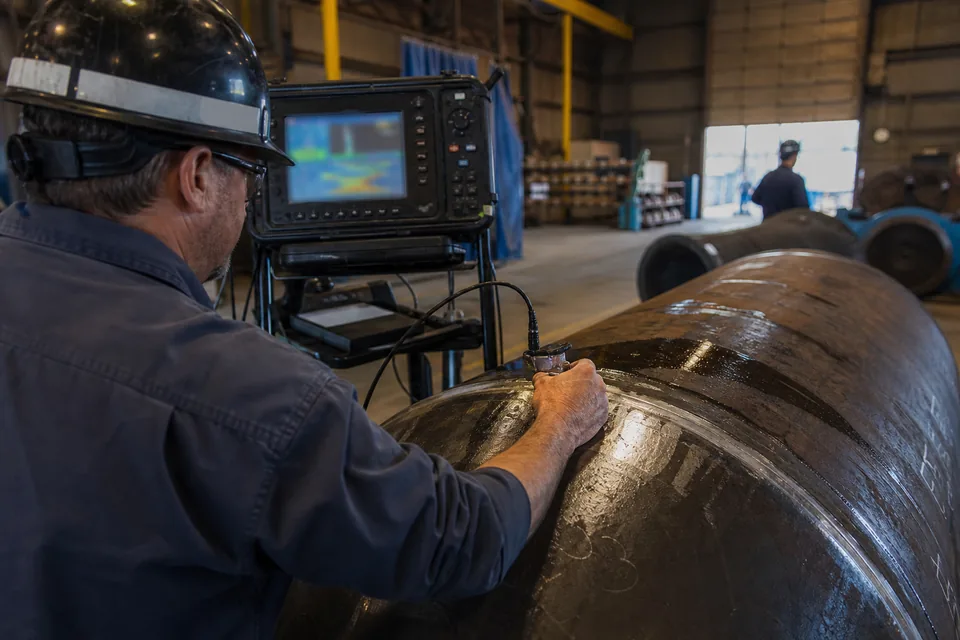
What PAUT inspects and what it replaces
| Job | PAUT technique | Why buyers pick it | Typical US range |
|---|---|---|---|
| Girth welds on new pipe | Encoded sectorial scan, often with TOFD | Replaces RT, no exclusion zone, permanent record | $40 to $150 per weld |
| Thick wall vessel and boiler welds | Dual linear array or sectorial, plus TOFD | Sizes flaw height for fitness for service | $1,500 to $3,200 per crew day |
| Corrosion mapping on pipe, tanks and vessels | Linear array C-scan | Maps wall loss across an area, not at single points | $1,500 to $4,000 per area |
| Hydrogen damage and cracks in service | Sectorial scan, shear wave | Finds and sizes planar flaws | $1,800 to $3,500 per day |
| Nozzle and branch welds | Matrix or custom wedge | Reaches awkward geometry that RT cannot | $200 to $800 per nozzle |
| Composite parts and bonded joints | Immersion or roller array C-scan | Shows delamination as an image | $150 to $900 per part |
| Rail, forgings and shafts | Special wedges, array scans | Fast coverage of long or round parts | By quote |
These are planning ranges, not quotes. Wall thickness, weld prep, scan length and reporting rules move the price. See the full ultrasonic testing services page for conventional UT and thickness work.
When phased array beats radiography and conventional UT
PAUT wins when you need coverage and a record without shutting the area down. Radiography needs a radiation exclusion zone and often an overnight shift, while an array scan runs with people working nearby. Conventional UT needs several angles and several passes, and it saves no image, so a second inspector cannot check the call. With PAUT the scan file holds every A scan, so a Level III can re-read it a year later.
Radiography still wins on thin wall small bore pipe, on complex castings and where the code or client names RT. If your specification says RT only, ask whether a code case or written client approval allows PAUT before you quote the job. The radiographic testing cost guide shows what the film or digital alternative costs per weld.
Who buys phased array ultrasonic testing services
Pipe fabricators and pipeline contractors buy PAUT with TOFD on girth welds to ASME B31.3 or API 1104 so they can release welds the same day. Refinery and chemical plant reliability engineers buy corrosion mapping and crack sizing during turnarounds. Boiler and vessel owners buy it on thick weld seams and nozzle welds. Wind tower and structural fabricators use it for long seams. Each of them sends the same request for quote to certified NDT crews, which is the step we automate. For process piping campaigns see piping inspection services, and for weld work in general see pipe weld testing.
How a phased array inspection job runs
- You send the weld list or drawing with material, diameter, wall thickness, process and the code that applies.
- The company proposes the probe, wedge and scan plan and tells you whether TOFD is paired with PAUT.
- The technician cleans the weld cap, sets an encoder on a scanner and calibrates on a reference block of your material.
- The scan is recorded, a Level II reviews the data against the acceptance criteria and a Level III signs off where the code asks.
- You receive a report with flaw positions, lengths and heights, and the native scan files.
What phased array ultrasonic testing costs
- Crew day with PAUT equipment. $1,500 to $3,200.
- Girth welds on a repeat fabrication job. $40 to $150 per weld, depending on diameter.
- Corrosion mapping of a vessel shell or tank floor section. $1,500 to $4,000 per area.
- Data analysis and reporting. Often 20 to 40 percent on top of scan time.
- Mobilization and travel. $500 to $3,000 per trip.
- Scaffolding, insulation removal and surface cleaning. Billed on top.
For how PAUT pricing compares with simple UT and TOFD, read ultrasonic testing cost. For weld work against radiography see phased array weld inspection vs radiography.
What to put in your PAUT request for quote
- 01Weld or area list with diameter, wall thickness, material and joint type.
- 02Code and acceptance criteria, for example ASME B31.3, ASME VIII or API 1104, and whether PAUT is allowed in place of RT.
- 03Whether TOFD is required with PAUT and who supplies the procedure.
- 04Surface condition, access, temperature and insulation.
- 05Deliverables: report format, native scan files, Level of the reviewer.
- 06Site dates, shift rules and permit requirements.
How to choose a PAUT company
Ask for the technician's PAUT certification (ASNT Level II or III in the technique, not only conventional UT), a written procedure demonstrated on a block like yours and a sample encoded report. For refinery work many owners require API QUPA personnel for phased array flaw sizing, see the API certification programs. Check the equipment calibration records and ask who reviews the data.
FAQ
How much do phased array ultrasonic testing services cost?
PAUT in the US typically costs $1,500 to $3,200 per crew day including equipment and a technician, or $40 to $150 per weld on repeat work. Corrosion mapping of an area runs $1,500 to $4,000. Reporting, travel and access are extra.
What is the difference between PAUT and conventional ultrasonic testing?
Conventional UT uses a single element and one angle per pass. PAUT uses many elements to steer and focus the beam, covers more volume per scan and saves an image of the weld. That record is the main reason owners pay more for it.
Can phased array replace radiography?
Often yes, when the governing code or client approves it and a qualified procedure is used. PAUT with TOFD is widely used on thicker welds in place of RT, and it avoids radiation exclusion zones. Thin small bore pipe usually stays with RT.
What certification should a PAUT technician hold?
Look for ASNT Level II or III in phased array, plus a written procedure and a demonstration on a reference block. Refinery owners often also ask for API QUPA personnel for flaw sizing in service.
What is PAUT used for besides welds?
PAUT also maps corrosion on pipe, tanks and vessels as a C-scan, finds and sizes cracks in service and checks bonded composites. It suits long welds and areas where you need coverage and a record, not a single reading.
Get matched with phased array ultrasonic testing companies
Describe the weld or asset in the inspection method advisor, with material, thickness and code. It chooses PAUT, TOFD or another method, builds a complete request for quote and sends it to NDT companies that list phased array and cover your state. You compare quotes on the same scope.
- 01What needs inspecting
- ...
- 02Material
- ...
- 04Concern
- ...
Run an NDT company with phased array capability? List your company
Show your PAUT and TOFD equipment, your certified technicians and the states you cover, and receive matched weld and corrosion mapping RFQs. Learn more for providers.