Typical ultrasonic testing prices by job
Ranges for US NDT companies, for budgeting before you request quotes. Remote sites, night shifts and rope access work sit at the top of each band.
| Job and scope | Typical planning range | What to confirm in the quote |
|---|---|---|
| Conventional UT, Level II technician, hourly | $90 to $175 per hour | Minimum hours, travel time billed or not |
| Phased array (PAUT) or TOFD, Level II, hourly | $150 to $300 per hour | Encoded scan, data delivery, Level III review |
| Thickness gauging of vessels, tanks and piping | $5 to $25 per reading | Grid pattern, surface prep, insulation removal |
| Conventional UT of a weld | $50 to $250 per weld | Weld size, code acceptance table |
| PAUT or TOFD of a girth weld with stored scan | $100 to $400 per weld | Report per weld, raw data kept |
| Corrosion mapping, per square foot scanned | $10 to $60 per square foot | Resolution, mapping software, report format |
| Field crew, technician and equipment | $800 to $3,200 per day | Hours on site, per diem, standby |
| Procedure writing and qualification | $1,000 to $4,000 per procedure | Mock up blocks, Level III time |
| Mobilization and travel, remote sites | $500 to $3,000 per trip | Mileage, travel days, hotel |
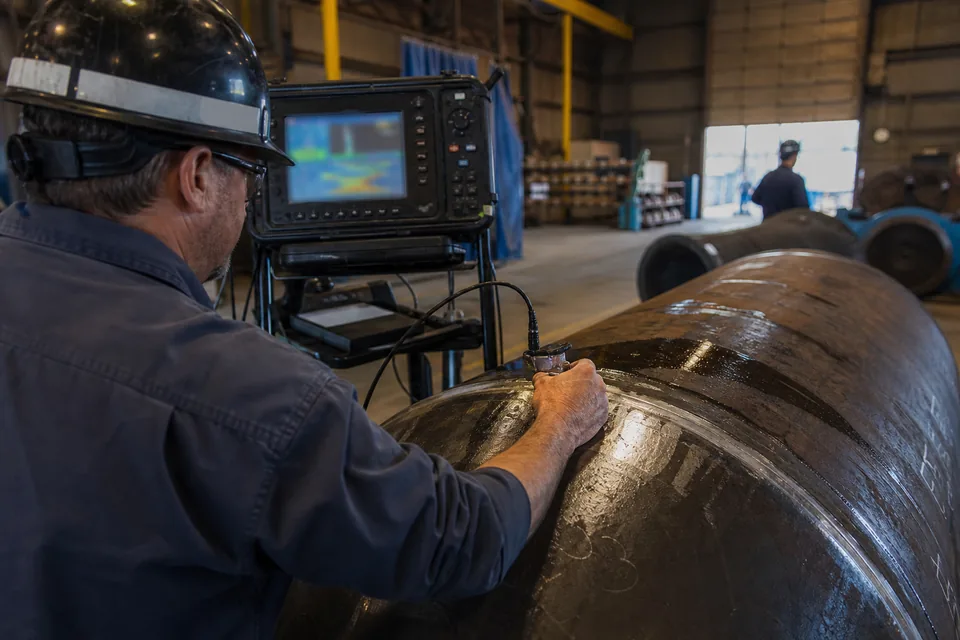
Our ultrasonic testing services page explains what UT finds and where another method fits better, and the pipe weld testing page applies the same prices to piping jobs.
What drives ultrasonic testing pricing
- Technique. Straight beam thickness gauging is the cheapest UT. Angle beam weld scanning takes longer, and PAUT and TOFD need more expensive equipment, setup and a trained operator, but they store data and often finish faster on thick welds.
- Technician level. A Level III writing procedures bills at a higher rate than a Level II doing the scanning. A job that needs a signed procedure adds hours before the first scan.
- Access. Scaffolding, insulation removal, hot surfaces, confined spaces and rope access can double the time per reading. A flat shop part is far cheaper than a tower or a tank roof.
- Surface condition. Paint, scale and rough welds must be cleaned before coupling gel sticks, and that prep is either billed by the hour or assigned to the owner.
- Volume. A crew gets faster after the first dozen welds. Ten welds cost much more per weld than two hundred because setup and mobilization are spread out.
- Reporting. A one page pass or fail summary is cheap. A report per weld with stored scans, indication sizing and a drawing markup takes real time.
- Code. Aerospace and nuclear acceptance requires qualified procedures and documented calibration, which adds hours.
Illustrative quotes with the scope added up
These examples show how a quote is built. They use the planning ranges above and are not offers.
| Scenario | How the quote adds up | Planning total |
|---|---|---|
| Thickness survey of a 12 foot diameter vessel, 400 readings, insulation windows cut by owner | 400 readings at $12, technician half day minimum, report $300 | About $5,100 |
| 60 pipe girth welds, PAUT, shop spools, stored scans | 60 welds at $220, setup and procedure $1,800 | About $15,000 |
| One day of conventional weld UT on a structural job, 20 welds | Crew day $2,200, report $400 | About $2,600, or $130 per weld |
| Shutdown corrosion mapping of 80 square feet on a tank floor | 80 square feet at $35, mobilization $900 | About $3,700 |
Per hour, per weld or per day
Hourly pricing fits small and uncertain scopes because you only pay for time spent, but it leaves you holding the risk if access is slow. Per weld or per reading pricing fits repeat work where the technician can run a rhythm. A day rate fits shutdowns and field campaigns, where you are buying a technician and equipment for a fixed window. Ask each company to price the same scope all three ways if you are unsure, and compare the totals. If a quote is much lower than others, check whether it excludes travel, minimums, reporting or standby, because those are the common ways a low rate grows into a high invoice.
Charges to settle before the technician arrives
- Minimum charge, usually four hours or half a day, and whether travel time counts toward it.
- Overtime, night, weekend and holiday multipliers, often 1.5 times or 2 times the base rate.
- Standby when the owner is not ready, and who pays for it.
- Surface preparation and insulation removal.
- Couplant, calibration blocks and consumables, usually in the rate but not always.
- Data delivery. Ask for raw PAUT and TOFD files in a standard format so the scan data is yours.
- Rework. A rejected weld must be repaired and retested, so ask what a retest costs.
How to lower ultrasonic testing cost
Bundle thickness readings, weld checks and corrosion mapping into one mobilization. Prepare the surfaces and remove insulation before the crew arrives. Give the company the drawing, the code and the acceptance table with the request, so it does not quote extra hours for questions. Agree on a report template once and reuse it each year so reporting time falls. Use the method that fits the question: if you only need to know whether the wall is still thick enough, straight beam gauging costs far less than PAUT. If you plan to rent equipment and train staff instead of hiring a crew, compare it against the cost of a technician certified to SNT-TC-1A and the annual calibration. For recurring shutdown work, a purchase order and vendor tracking in a procurement software system makes it easier to hold three competing quotes against the same specification.
What to send for comparable ultrasonic testing quotes
- Item to test: welds, plate, pipe, vessel, tank floor, forging or casting, with material and thickness.
- Quantity: number of welds or readings, or square feet to map.
- Governing code and acceptance criteria, for example ASME Section V and VIII or API 510.
- Location, access, scaffolding, insulation, temperature and confined space entry.
- Method wanted, or ask the company to propose one: thickness gauging, angle beam, PAUT, TOFD or corrosion mapping.
- Technician qualification required, such as ASNT Level II.
- Deliverables: report format, raw data, drawing markup, indication sizing.
- Dates, shift pattern, who supplies power and permits.
How much does ultrasonic testing cost?
Ultrasonic testing in the US usually costs $90 to $175 per hour for conventional UT and $150 to $300 per hour for phased array or TOFD. Per item, expect about $5 to $25 per thickness reading and $50 to $400 per weld, with a field crew day at $800 to $3,200 plus travel.
How much does an ultrasonic thickness test cost?
A thickness survey commonly costs $5 to $25 per reading, with a technician minimum of about half a day. Access, insulation removal and the size of the grid change the total, so a vessel with 400 readings often lands between $3,000 and $6,000 including a report.
Is phased array more expensive than conventional UT?
Per hour, yes, by about $60 to $125. Per weld on thick or long welds it can cost the same or less, because the scan is faster and the stored data replaces a second inspection. It also gives a permanent record, which matters in disputes.
What affects the cost of UT inspection?
Technique, technician level, access, surface condition, number of items, the depth of the report and the code you work to. Travel, minimum charges, overtime and standby are the most common extras, so ask for them in writing.
Is ultrasonic testing cheaper than radiography?
Often yes on thick material and on large numbers of welds, because UT needs no radiation controlled area and the crew can work alongside other trades. On thin walls RT can be cheaper per weld. Check both methods with the code before you decide.