Pipe weld testing and pipe weld inspection with RT, UT and PAUT
Pipe weld testing checks girth and branch welds in process, power and pipeline piping for cracks, lack of fusion, incomplete penetration, porosity and slag without cutting the pipe. Most jobs use radiography (RT) or ultrasonic testing (UT, PAUT or TOFD) for the volume of the weld, plus magnetic particle or liquid penetrant testing for surface flaws, all read against the acceptance criteria of the code your project follows, such as ASME B31.3 or API 1104. Typical US crew pricing is $50 to $250 per weld for RT or UT and $1,500 to $3,500 per crew day in the field, with reports in one to five business days.
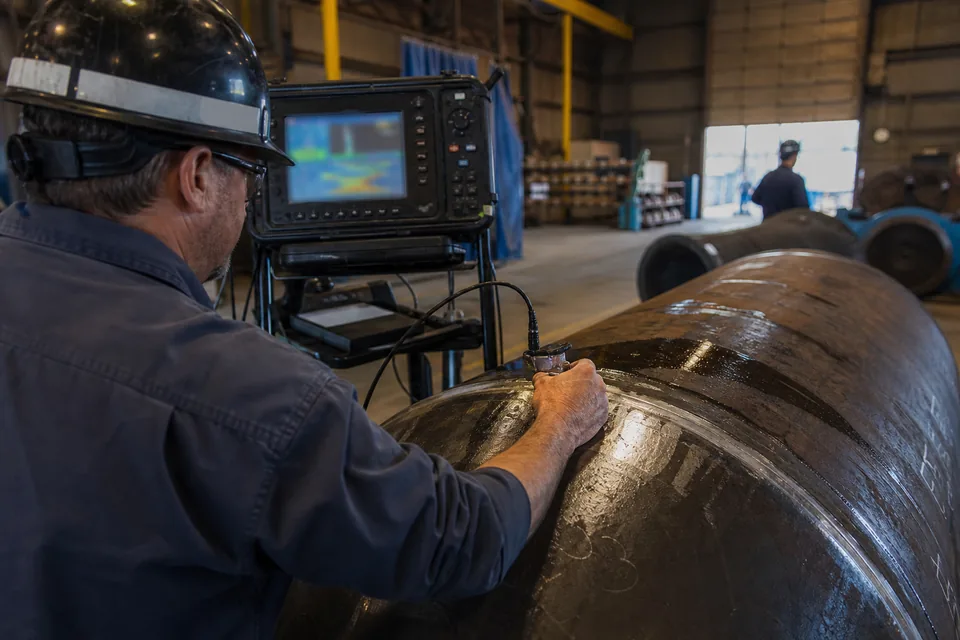
Which method tests a pipe weld
- Radiography (RT) shoots through the weld wall with an X-ray tube or an iridium or selenium source. It records porosity, slag, lack of fusion and burn through as a permanent image, and it is the classic acceptance method for process piping. Digital radiography removes film processing and gives results in minutes.
- Phased array and TOFD ultrasonic testing (PAUT, TOFD) sweep sound through the weld and store the full scan. They find planar flaws such as lack of fusion and cracks better than RT, need no exclusion zone for radiation and are often used on thick wall piping. Our ultrasonic testing services page explains where UT beats RT and where it does not.
- Magnetic particle (MT) and liquid penetrant (PT) testing find flaws that open to the surface, for example on root and cap passes, socket welds and attachment welds. See magnetic particle inspection and liquid penetrant testing.
- Visual testing (VT) by a certified welding inspector comes first on every weld. It catches undercut, reinforcement, misalignment and arc strikes before money is spent on volumetric methods.
- Eddy current and borescope work cover small bore tubing and the inside of piping that cannot be reached from outside. See borescope inspection.
ASME B31.3, B31.1 and API 1104 decide how much to test
The method and the share of welds you test come from the construction code, not from the NDT company. ASME B31.3 for process piping sets examination by fluid service: normal fluid service commonly calls for visual examination of every weld and random radiography or ultrasonic examination of a percentage of girth welds, while severe cyclic conditions and high pressure categories raise that to 100 percent. ASME B31.1 for power piping ties volumetric examination to pipe size and wall thickness. Cross country pipelines are normally welded and tested to API 1104, which accepts RT or UT of girth welds and, for most lines, requires a high share of welds to be examined. Pressure vessel nozzles and shop spools follow ASME Section VIII and Section V for technique. Your piping class, line list or specification names the code, the examination percentage and the acceptance criteria, and the NDT company interprets the results against them. Always send those documents with the request, because a lab that guesses the acceptance table gives you a report your inspector will reject.
Who should test your welds
Ask for technicians qualified to ASNT SNT-TC-1A or CP-189 at Level II for each method, with a Level III on call for procedure approval. For visual acceptance, a certified welding inspector (AWS CWI) is the norm. Pipeline and nuclear work often add owner specific qualifications, and PAUT or TOFD needs operators who have passed a practical on weld samples with known flaws, not just a written exam. Radiography crews also need radiation safety certificates and a state or NRC license for gamma sources.
Who buys pipe weld inspection
Mechanical contractors and pipe fabricators order RT or UT on spools to close out a turnover package. Plant owners buy it for shutdowns, tie ins and repair welds after a leak or a failed hydrotest. EPC project teams and owner inspectors hire third party NDT to sign off welder performance after a high reject rate. Facility managers add UT on high energy and steam piping at scheduled outages. Pipeline operators test girth welds on new construction and on integrity digs. Each of these buyers needs a firm price per weld or per crew day, a start date and a report format that matches the contract.
How a pipe weld testing job runs
- You send the line list or isometrics, pipe size and schedule, material, number of welds, the code and the examination percentage.
- The NDT company selects a method and technique, often with a written procedure for your engineer to approve.
- A crew arrives with the equipment, marks and identifies each weld, and tests in the agreed window. RT often runs at night or on weekends so other trades stay out of the controlled area.
- A Level II reads the results and records every indication against the acceptance table.
- You receive a report per weld with the technique, the result, and the images or scan data. Rejected welds go back for repair and a retest.
Small shop jobs usually turn in one to three business days. Field crews often deliver a daily summary and the final report in three to five.
What pipe weld testing costs
These are typical US planning ranges, not quotes. Pipe size, wall thickness, access, shift work and report requirements set the real price.
| Job type | Typical range, not a quote |
|---|---|
| Visual examination by a certified welding inspector | $75 to $150 per hour |
| RT of pipe welds in the shop, small to mid size pipe | $40 to $150 per weld |
| RT of field pipe welds, source, crew and darkroom or digital | $75 to $250 per weld |
| PAUT or TOFD of a girth weld, with stored scan | $100 to $400 per weld |
| MT or PT of a weld, per weld | $50 to $150 per weld |
| Field crew with a Level II technician and equipment | $1,500 to $3,500 per day |
| Mobilization and travel, remote sites | $500 to $3,000 per trip |
| Retest of a repaired weld | Usually the same rate as the first test |
Most companies set a minimum charge of about half a day, so grouping welds into a single visit is the main way to lower the price per weld. Our guide to NDT inspection cost shows how crews build quotes across methods, and the ultrasonic testing cost guide goes deeper on UT day rates.
What to put in your pipe weld testing RFQ
- 01Governing code and edition, for example ASME B31.3 normal fluid service or API 1104, and the examination percentage.
- 02Line list or isometrics with pipe size, schedule, material and number of welds.
- 03Weld type: butt, socket, branch, or attachment, and joint preparation.
- 04Methods wanted, or ask the company to propose them against the code.
- 05Location, access, scaffolding, lighting and whether other trades work nearby during radiography.
- 06Acceptance criteria table and the report format your owner expects.
- 07Technician qualification required, such as ASNT Level II and AWS CWI.
- 08Schedule, shift pattern and who supplies power, permits and escort.
How to choose a pipe weld inspection company
Match capability to your piping class first. Ask whether the company holds the radiation license for the source type you need, whether it can run PAUT with encoded scans, and which procedures it already has approved on similar lines. Ask for a sample report per weld, not a summary sheet. Check that the Level III who signs procedures is on staff or on a retainer, and that the company can mobilize on short notice for shutdown work. Our page on NDT companies lists how to compare providers on scope instead of the lowest unit price alone. For buried and long distance lines also see pipeline inspection.
FAQ
How are pipe welds tested?
Pipe welds are tested by visual examination first, then by radiography or ultrasonic testing for the inside of the weld, with magnetic particle or liquid penetrant testing for surface flaws. The code for the line sets which methods apply and what share of welds must be examined, and a qualified technician reads each result against the acceptance table.
How much does pipe weld testing cost?
In the US, radiography or ultrasonic testing of a pipe weld typically costs $50 to $250 per weld, and a field crew costs $1,500 to $3,500 per day. Phased array UT with a stored scan sits at $100 to $400 per weld. Most companies charge a half day minimum, plus travel for remote sites.
Is RT or UT better for pipe welds?
RT gives a permanent image and is the traditional choice for process piping. UT, PAUT and TOFD detect planar flaws such as lack of fusion more reliably, need no radiation controlled area and store the full scan. Many projects allow both, so pick the one that suits the wall thickness, schedule and access.
What percentage of pipe welds must be tested?
It depends on the code and service. ASME B31.3 normal fluid service commonly requires visual examination of every weld and random RT or UT of a percentage, while severe cyclic or high pressure categories can require 100 percent. Check the line class or piping specification for the exact number.
Who can perform weld inspection on pipe?
Visual acceptance is normally done by a certified welding inspector (AWS CWI), and RT, UT, MT and PT by technicians qualified to ASNT SNT-TC-1A at Level II or higher, with a Level III approving procedures. Radiography also needs a radiation safety certificate and a source license.
How long does pipe weld testing take?
A crew can shoot or scan from a few dozen to over a hundred welds a day, depending on size and access. Shop work is usually reported in one to three business days. Field jobs commonly give a daily summary and a final report within three to five business days.
Get matched with pipe weld testing crews
Describe your piping in the inspection method advisor: size, wall, material, code and number of welds. It checks whether RT, UT, PAUT or a surface method answers your question, then turns your answers into a complete request for quote and sends it to NDT companies that list the right methods, qualifications and service area. You compare quotes on the same scope instead of repeating the job description to five companies.
- 01What needs inspecting
- ...
- 02Material
- ...
- 04Concern
- ...
Run an NDT company that tests pipe welds? List your company
Show your methods, qualifications, procedures and service area, and receive matched pipe weld testing RFQs. Learn more for providers.