Piping inspection services for API 570 process piping
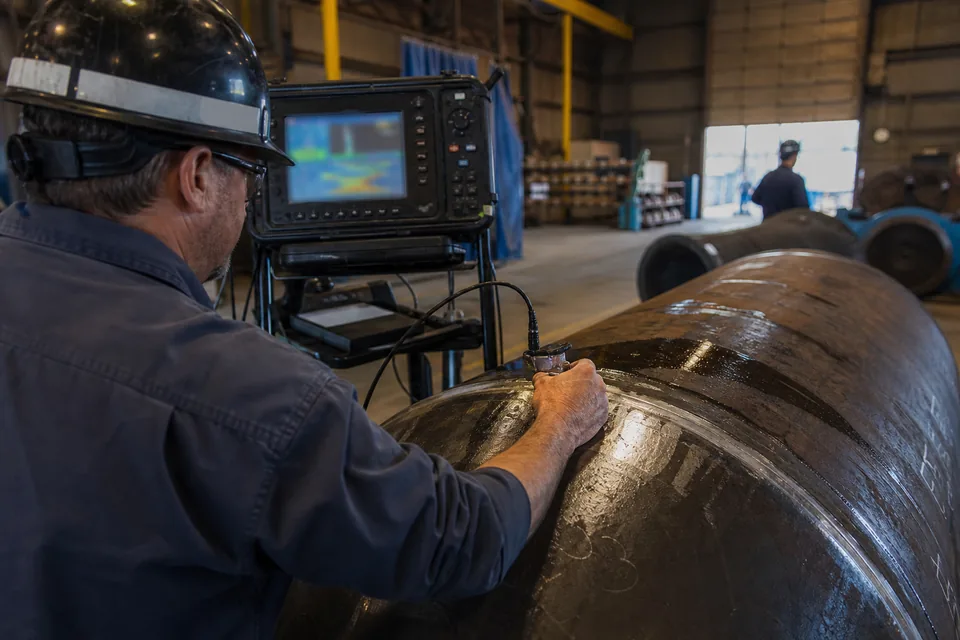
Piping inspection services test process piping in refineries, chemical plants, power stations and food plants so you can meet API 570 and show remaining life for every circuit. A crew measures wall thickness at condition monitoring locations (CMLs), checks welds with radiography or phased array, looks under insulation for corrosion and delivers a corrosion rate per circuit. In the US a circuit typically costs $800 to $6,000 to inspect, and a full unit campaign runs $15,000 to $150,000, before insulation removal and scaffolding.
Which method inspects which piping problem
| Piping problem | Method | What it finds | Typical US range |
|---|---|---|---|
| General wall loss on lines in service | UT thickness at CMLs | Internal corrosion and erosion rate | $800 to $4,000 per circuit |
| Corrosion under insulation (CUI) | Profile RT, pulsed eddy current, insulation windows | Wet insulation, external pitting | $1,200 to $6,000 per circuit |
| Small bore connections and nipples | Profile RT, UT, PT | Vibration cracks, thinning | $50 to $200 per connection |
| Butt welds in new or repaired pipe | RT, PAUT, TOFD | Lack of fusion, porosity, cracks | $60 to $250 per weld |
| Injection points and mix points | UT scanning grid, PAUT | Localised thinning | $1,500 to $8,000 per point |
| Dead legs and low flow lines | UT, profile RT | Stagnant corrosion | $300 to $1,200 per leg |
| Buried or road crossing lines | Guided wave, excavation and UT | Coating failure, external pitting | $2,500 to $12,000 per section |
These are planning ranges, not quotes. Pipe size, schedule, insulation and access decide the real price.
What API 570 asks you to inspect
API 570 covers in service inspection, repair and rerating of metallic process piping. Owners classify each circuit by consequence of failure, from Class 1 for flammable or toxic service to Class 3 for low risk lines, and the class sets the visual, thickness and CUI inspection intervals. Thickness readings taken at CMLs give a corrosion rate and a remaining life, and the shorter of half the remaining life or the class limit sets the next date. The code is published by the American Petroleum Institute, and the inspector who signs the plan must hold API 570 certification. The same logic for tanks and vessels is on our storage tank and pressure vessel pages.
Where piping inspection money goes
Thickness work is the base of most contracts, but the larger bills come from what surrounds it. Insulation has to be opened or removed to read the pipe. Elevated lines need scaffolding or rope access. Hot lines need cool down or a high temperature probe. Lines in hydrogen, caustic or amine service may add targeted checks such as PAUT for cracking. Ask the quote to separate NDT labour, access and insulation work, since access is often the larger share. For weld level testing on new work see pipe weld testing.
Who buys piping inspection services
Refinery and chemical plant reliability engineers buy circuit campaigns before a turnaround. Power plant owners test steam and feedwater lines for flow accelerated corrosion. Food, beverage and pharma plants inspect process and utility piping for insurers. Oil and gas operators check pipework at processing sites, covered further on the oil and gas industry page. Maintenance planners buy it to defend an interval extension or to prove a repair did the job.
How a piping inspection job runs
- You send isometrics or a line list, with pipe size, schedule, material, service and last thickness readings.
- The company proposes CML locations, methods and crew size, and flags insulation to open.
- Technicians clean the spot, take UT readings or shoot profile radiographs and mark each location on the isometric.
- A qualified inspector reviews the data, calculates corrosion rates and remaining life per circuit.
- You receive a report with CML tables, rates, next inspection dates and repair recommendations.
What piping inspection costs
- Straight UT thickness on a small circuit, 20 to 60 CMLs. $800 to $2,500.
- Large circuit with CUI checks and profile RT. $3,000 to $6,000.
- Weld RT on repaired piping. $60 to $250 per weld.
- Insulation removal and reinstall. $15 to $60 per linear foot.
- Scaffolding. Often $1,000 to $10,000 per area.
- Mobilization and travel. $500 to $3,000 per trip.
Night shifts, turnaround standby and rush reports add premiums. See NDT inspection cost for how crews price the underlying methods, and ultrasonic testing cost for UT rates.
What to put in your piping inspection RFQ
- 01Site, circuits and a line list with size, schedule, material, fluid, temperature and pressure.
- 02Isometrics or P&IDs and the existing CML numbering.
- 03Scope: CMLs, CUI, small bore, injection points, dead legs.
- 04Code and insurer requirements, including API 570 class per circuit.
- 05Insulation, scaffolding and cleaning: who supplies what.
- 06Deliverables: CML tables, corrosion rates, remaining life, native data.
- 07Outage window and permit rules.
How to choose a piping inspection company
Ask for UT technicians certified to ASNT Level II or higher and an API 570 inspector on the job. Request a sample report on a circuit like yours, check that CML numbers carry over from year to year and ask how they calibrate on your pipe material. See the ASNT pages for what technician levels mean, and confirm insurance and site safety records.
FAQ
How much do piping inspection services cost?
Piping inspection in the US typically costs $800 to $6,000 per circuit, and $15,000 to $150,000 for a full unit campaign. Insulation removal, scaffolding and cleaning are billed separately and often exceed the NDT itself.
What does an API 570 inspection include?
An API 570 inspection includes external visual checks, thickness readings at condition monitoring locations, checks for corrosion under insulation and a review of records. The result is a corrosion rate, remaining life and next inspection date per circuit.
How often does process piping need inspection?
Intervals follow the API 570 class and measured corrosion rate. Thickness is commonly checked every five to ten years, never longer than half the remaining life, and Class 1 lines are inspected more often than Class 3 lines.
What methods find corrosion under insulation?
Profile radiography, pulsed eddy current and opening insulation windows are the common choices. Profile RT shows wall loss through the insulation, while windows allow direct UT. The best choice depends on pipe size and insulation type.
Can piping be inspected while in service?
Yes. UT thickness, profile RT and pulsed eddy current work on lines in service, including hot lines with the right probe. Internal visual work and some weld tests need the line shut down and cleaned.
Get matched with piping inspection companies
Describe the circuit in the inspection method advisor, with size, service and insulation. It picks the methods that answer your question, builds a complete request for quote and sends it to NDT companies that list those methods and cover your state. You compare quotes on the same scope.
- 01What needs inspecting
- ...
- 02Material
- ...
- 04Concern
- ...
Run an inspection company that serves process piping? List your company
Show your UT, RT and PAUT capability, your API 570 inspectors and the states you cover, and receive matched piping RFQs. Learn more for providers.