Positive material identification services for alloy piping and vessels
Positive material identification services (PMI) check that the alloy in a pipe, fitting, weld or vessel is the grade the drawing says, before a wrong material reaches a hot, corrosive or high pressure line. A technician reads the chemistry with a handheld XRF analyzer or an optical emission spectrometer (OES) and reports the grade against your specification. In the US a PMI crew typically costs $900 to $1,800 per day with equipment, or $5 to $25 per component on a large count. Describe the job below and we send one request for quote to PMI companies that cover your state.
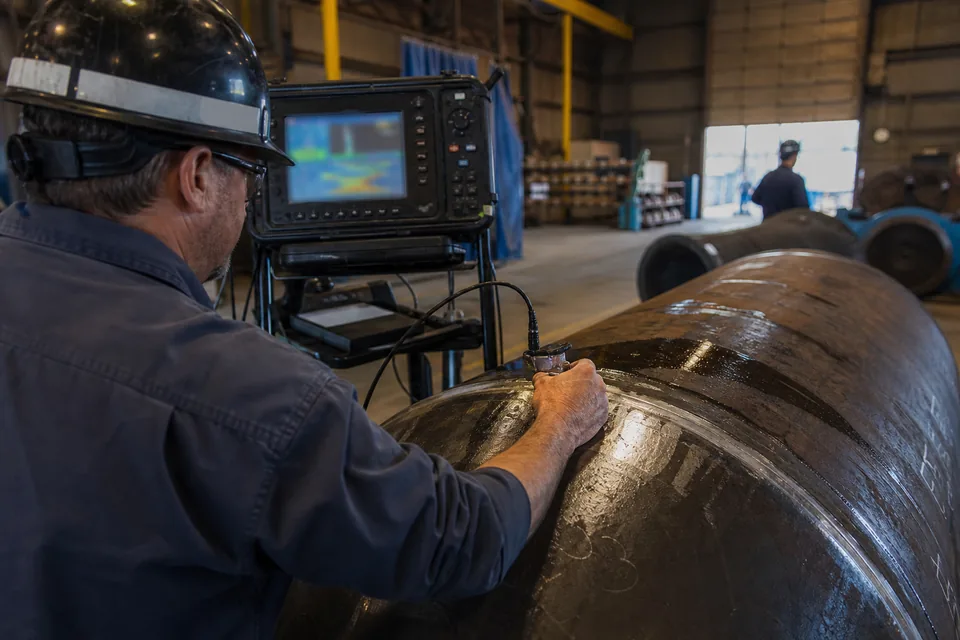
Which PMI method reads which alloy
| Job | PMI method | What it confirms | Typical US range |
|---|---|---|---|
| Stainless and alloy pipe, fittings, flanges | Handheld XRF | Chromium, nickel, molybdenum and other alloy elements, grade match | $5 to $25 per component |
| Welds and weld filler on alloy piping | Handheld XRF | Filler and weld metal chemistry against the procedure | $15 to $60 per weld |
| Carbon content in 304L vs 304, 316L vs 316 | OES (spark) | Low carbon grades that XRF cannot read | $50 to $150 per point |
| Low alloy steel such as P11 and P22 | XRF for chromium and molybdenum, OES for carbon | Chrome moly grade for high temperature service | $15 to $80 per point |
| Vessel shells, heads, nozzles | XRF on bare metal | Base metal and cladding or overlay | $900 to $1,800 per day |
| Incoming material at a fabricator or warehouse | XRF on bar, plate and fittings | Heat lot and grade before use | $5 to $20 per piece |
| Valves, bolting and small parts | XRF, sometimes OES | Body and trim material | $5 to $30 per part |
These are planning ranges, not quotes. Surface condition, alloy family, count and the report you need change the price. For the weld side of the same job see pipe weld testing.
Why owners buy PMI on alloy systems
A mix up between 304 and 316, or carbon steel in a chrome moly line, usually looks fine until the line corrodes or creeps. PMI is the cheap check that catches it at receiving, at fabrication or in an existing plant. Refineries and chemical plants run PMI programs on high temperature, sour and corrosive service because the consequence of a wrong alloy is a leak, a shutdown and a repair that costs many times the test. The recommended practice for this is API RP 578, which covers material verification programs for new and existing alloy piping, and many purchase orders also cite ASTM E1476 for metals identification. Your owner specification and your insurer decide how many components to test, often 100 percent for critical alloy lines.
Who buys positive material identification services
Pipe fabricators buy PMI on incoming pipe, fittings and filler to release alloy spools with a record. EPC contractors and plant owners buy it as a receiving inspection and as a condition for turnover. Refinery and chemical plant reliability engineers buy PMI during API 570 and API 510 programs when records are missing or a system moves to harsher service. Valve and equipment distributors buy it to certify stock against heat numbers. Process piping campaigns are covered on our piping inspection services page, and vessels on pressure vessel inspection services. Each of them sends the same request for quote to qualified crews, which is the step we automate.
Handheld XRF or OES for your alloy
Handheld XRF is the default. It is fast, nondestructive and reads most alloy elements in a few seconds, so a technician can test hundreds of components in a day. It cannot measure carbon, so it cannot tell 304 from 304L or 316 from 316L. When the specification calls for a low carbon grade, or you need to separate chrome moly grades, the crew adds OES, which burns a tiny spot on the surface and reads carbon directly. Ask each bidder which method they use for which grades and whether the quote includes both, so prices compare like for like. Light elements and coatings also affect XRF, so the surface must be bare, clean metal.
How a PMI job runs
- You send the line list or component list with the specified material grade for each item, the count and the code or owner specification.
- The company proposes the method, the sample plan and who marks the tested items.
- The technician checks the analyzer against a certified reference standard at the start of each shift, grinds or cleans test points and reads each component.
- Results are compared with the specified grade ranges, failures are retested and flagged, and tested items are marked.
- You receive a report with the component identifier, location, measured composition, specified grade and pass or fail.
What positive material identification costs
- Crew day with a handheld XRF analyzer. $900 to $1,800.
- Per component on a large count. $5 to $25 for pipe, fittings and flanges.
- Welds and filler metal. $15 to $60 per weld.
- OES carbon check. $50 to $150 per point, since it needs a spark spot and surface prep.
- Report and data package. Often 10 to 20 percent on top of field time, more with a per component spreadsheet.
- Mobilization and travel. $500 to $3,000 per trip for remote sites.
- Scaffolding, insulation removal and cleaning. Billed on top.
Minimums apply, so a 20 component job often costs close to a half day. The NDT inspection cost guide shows how crews price the other methods, and the PMI testing cost article works through a full alloy spool budget.
What to put in your PMI request for quote
- 01Component list or line list with specified grade, size and count.
- 02Sample plan: 100 percent, a percentage or random, and who sets it.
- 03Code or owner specification, for example API RP 578, the project PMI procedure or a purchase order clause.
- 04Which grades need carbon, for example 304L and 316L.
- 05Whether components are installed, insulated or in a warehouse, and who prepares test points.
- 06Marking requirements for tested and rejected items.
- 07Deliverables, such as a spreadsheet with measured composition per item.
- 08Site dates, shifts and safety rules.
How to choose a PMI company
Ask what analyzer the company uses, when it was last calibrated and how often it is checked against a standard during a shift. Ask who tests: ASNT Level II is common, and many owners require a written PMI procedure and a technician with alloy experience, not only a Level II certificate. Request a sample report showing measured composition per component, not only a pass stamp. For refinery work confirm the company knows API RP 578 and how it handles failures and retest.
FAQ
How much do positive material identification services cost?
PMI in the US typically costs $900 to $1,800 per crew day with a handheld XRF analyzer, or $5 to $25 per component on a large count. OES carbon checks run $50 to $150 per point. Report, travel and access are extra.
What is the difference between XRF and OES for PMI?
Handheld XRF reads most alloy elements in seconds without marking the part, but it cannot measure carbon. OES reads carbon by burning a tiny spot, so it separates 304 from 304L. Many alloy jobs use XRF for most items and OES for the low carbon grades.
Does PMI require certified technicians?
Codes and owner specifications set it. Many buyers require ASNT Level II or an equivalent, plus a written PMI procedure and an analyzer calibrated against a reference standard. Check your purchase order before you accept a quote.
How many components must be tested?
It depends on the owner specification and the service. Critical alloy lines in refineries and chemical plants are often tested at 100 percent, and lower risk systems use a percentage or random sample. API RP 578 gives the framework for setting the plan.
Can PMI be done on insulated or installed piping?
Yes, but the crew needs bare metal at each test point, so insulation removal and surface preparation add cost. Many owners test components at receiving instead, where access is free and a failure costs nothing to replace.
Get matched with positive material identification companies
Describe the job in the inspection method advisor, with the alloy grades, the component count and the specification. It builds a complete request for quote and sends it to NDT companies that list PMI and cover your state. You compare quotes on the same scope instead of repeating the job description to each vendor.
- 01What needs inspecting
- ...
- 02Material
- ...
- 04Concern
- ...
Run an NDT company that offers PMI? List your company
Show your XRF and OES equipment, your certified technicians and the states you cover, and receive matched PMI and alloy verification RFQs. Learn more for providers.