Hydrostatic testing prices by job type
Ranges for US test crews and NDT companies, for budgeting before you request quotes.
| Job | Typical US price | What moves it |
|---|---|---|
| Crew day with test pump, recorder and calibrated gauges | $1,200 to $3,500 per day | Pump size, test pressure, crew of two or three |
| Process piping system after fabrication, ASME B31.3 | $2,500 to $9,000 per system | Number of test boundaries, blinds, vents |
| Pressure vessel or exchanger after repair or alteration | $3,000 to $15,000 per vessel | Volume, test pressure, witness time |
| Exchanger tube side or shell side test | $2,000 to $8,000 per bundle | Test rings, gaskets, tube leak hunting |
| Storage tank water fill test | $4,000 to $20,000 per tank | Water volume, fill rate, settlement survey |
| Pipeline section strength and leak test | From about $15,000 per section | Length, diameter, water haul, dewatering and drying |
| Small spool or repair section | $1,500 to $6,000 | Half day minimum, mobilization |
| Water hauling and disposal | $0.05 to $0.30 per gallon | Distance, treatment, testing of discharge |
| Mobilization and travel | $500 to $3,000 per trip | Distance, remote sites |
These are planning ranges, not quotes. For the service itself, scope and code test pressures, see our hydrostatic testing services page.
Worked budget for a 400 foot process piping system
Take a new 6 inch schedule 40 carbon steel line, 400 feet long, in a chemical plant, designed for 285 psig and tested to ASME B31.3 at 1.5 times design, so about 430 psig.
- Water volume. A 6 inch schedule 40 pipe holds about 1.5 gallons per foot, so 400 feet is roughly 600 gallons. Plant water is available, so water cost is close to zero.
- Isolation. Six blinds at equipment nozzles and two test flanges, installed and removed by the crew, half a day.
- Fill, vent and pressurize. A small electric or air driven pump reaches 430 psig in under an hour, then a hold of at least 10 minutes and a walkdown of every joint.
- Crew. Two technicians for one and a half days at $1,800 per day, about $2,700.
- Gauges and chart. Included in the day rate with calibration certificates.
- Mobilization. $600.
- Disposal. Clean water to the plant drain with permission, near zero.
That gives roughly $3,500 to $4,500 for a single test boundary. If the line has to be split into three boundaries because a low rated valve sits in the middle, plan another half day per extra boundary. If a flange leaks, the crew stands by while the pipefitters fix it, and that standby time is billable. These numbers are illustrations, not offers.
Worked budget for one mile of 12 inch pipeline
Now take a 12 inch steel gas gathering line, one mile long, tested before commissioning.
- Water volume. A 12 inch line holds about 5.9 gallons per foot, so one mile needs roughly 31,000 gallons, plus 5 to 10 percent for fill losses.
- Water haul. With no hydrant nearby, trucks bring it in at $0.05 to $0.15 per gallon, about $1,600 to $4,700.
- Fill and test. Pigging, filling, pressurizing and an 8 hour strength test with a dead weight tester and recorder, two to three crew days at $2,500 to $3,500 per day.
- Dewatering and drying. Pigging the water out and drying the line before gas service, one to two days and often the largest single line.
- Disposal. Test water sampled and hauled or discharged under permit, $0.10 to $0.30 per gallon if hauled, about $3,100 to $9,300.
That lands near $20,000 to $45,000 for the mile, before excavation or tie in work. Federal rules set the test: 49 CFR Part 192, Subpart J for gas lines and Part 195, Subpart E for hazardous liquid lines, so give the crew the class location and the governing part.
What moves a hydrostatic test quote
Four things explain most of the spread between quotes. First, water. On a big vessel, tank or pipeline, sourcing, treating and disposing of the water can cost as much as the crew. Stainless steel systems often need low chloride water, which means buying or trucking it. Second, isolation. Blinds, test flanges, temporary supports for heavy water loads and vent points take longer than the pressure test itself. Third, test pressure. A higher pressure needs a larger pump, rated hoses and a wider exclusion zone. Fourth, what happens when the system does not hold. Ask every bidder how they bill standby while leaks are repaired, because that line is where change orders start.
A practical step before you request bids: walk the test boundary with your lead pipefitter and list every isolation point, vent, drain and low rated component. Some planning teams run that list through a brainstorming tool such as brainstormer.ai to catch the blinds and valves nobody remembered. Every item you settle before the bid is a change order you avoid on the day.
When you pay for NDT as well as the hydro
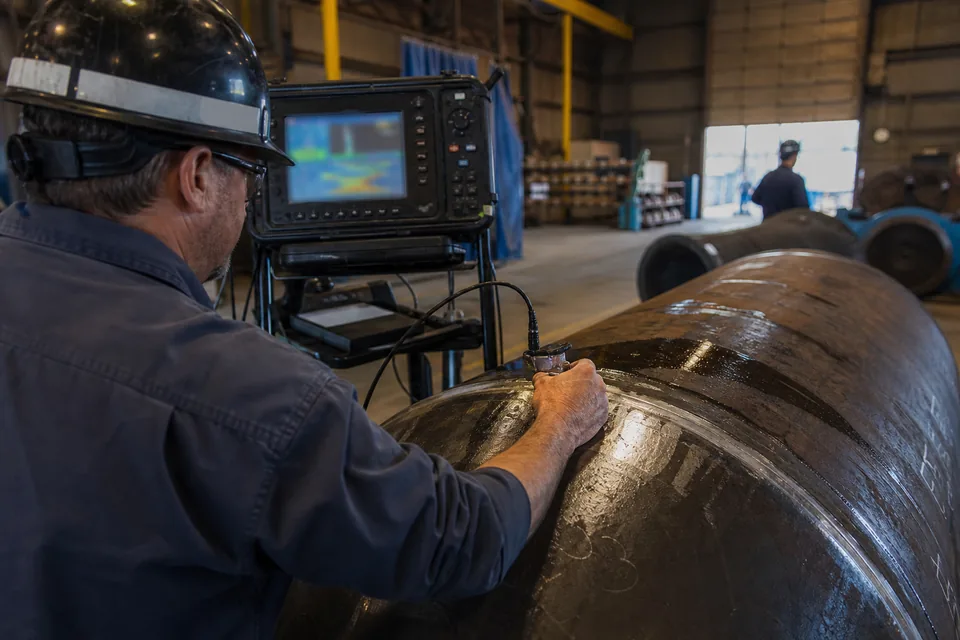
A hydro proves strength and tightness on the day of the test. It does not size corrosion or find a crack that stays closed under load. On repaired or rerated equipment, codes and owners usually require NDT of the repair welds before the hydro, such as radiographic testing or ultrasonic testing, and on in service vessels the inspector wants thickness data for the remaining life. Budget those separately. The pressure vessel inspection cost article shows how that inspection work is priced, and the NDT inspection cost guide covers the methods one by one.
Is a pneumatic test cheaper than a hydrostatic test?
Sometimes on paper, rarely in practice. A pneumatic test skips water handling and drying, which helps on systems that cannot be drained or where water would damage a lining. But compressed gas stores far more energy than water at the same pressure, so codes demand a lower test pressure, an engineer's approval, a larger exclusion zone and often extra NDT of welds beforehand. Those extras usually cancel the savings. Use a pneumatic test when water is not an option, not to save money.
What to send for comparable hydrostatic testing quotes
- Test boundary on a marked up P&ID or isometric, with line sizes and lengths, so the crew can compute the water volume.
- Design pressure, test pressure, hold time and the governing code or owner specification.
- Material of construction and any water chemistry limits.
- Water source on site, discharge rules and who pays for hauling and disposal.
- Who supplies blinds, test flanges and gaskets, and who installs them.
- Drying or preservation required after the test.
- Witness and hold points, and how standby during leak repairs is billed.
- Deliverables, such as the signed test record, pressure chart and gauge calibration certificates.
How much does a hydrostatic test cost?
A hydrostatic test on one piping system or pressure vessel typically costs $2,500 to $15,000 in the US. A crew day with pump and recorder runs $1,200 to $3,500. Pipeline sections start around $15,000 and depend mostly on length, water hauling, dewatering and disposal.
How much does hydrostatic testing cost per foot?
For plant piping, crews price per system or per day, which works out to a few dollars to $20 per foot on typical runs. Pipelines are priced per section, often $3 to $10 per foot for mid size lines once water and drying are included. Short runs cost more per foot because of minimums.
Who pays for hydrostatic testing on a new project?
Usually the fabricator or mechanical contractor, since the test is part of the turnover package in the contract. For repairs and rerates the owner pays. Read the contract and the specification, because the test, the water and the disposal can sit with different parties.
How long does a hydrostatic test take?
The pressure hold may be only 10 minutes for plant piping, but setup, isolation, fill and drain usually take one to two days per system. Pipeline strength tests often hold for 4 to 8 hours or more, and dewatering and drying add days.
Can a failed hydrostatic test cost more?
Yes. When a joint leaks, the crew stands by while it is repaired, then refills and retests, and both standby and the retest are normally billable. Clear isolation, tested flanges and NDT of repair welds before the test are the cheapest insurance against a second visit.