Boiler inspection services for NBIC and ASME power boilers
Boiler inspection services check the drums, tubes, headers, nozzles and welds of a steam or hot water boiler so you know it can run safely until the next outage. A commissioned inspector leads the statutory inspection under the National Board Inspection Code (NBIC) and your state rules, and NDT crews supply the method work: ultrasonic thickness on waterwall and superheater tubes, EMAT for fireside scale and corrosion, magnetic particle testing on drum and header welds, phased array (PAUT) on thick seams and borescope checks inside headers. In the US a boiler NDT scope typically costs $1,500 to $8,000 for a package boiler and $10,000 to $60,000 for a utility scale unit during an outage, before scaffolding, cleaning and shutdown.
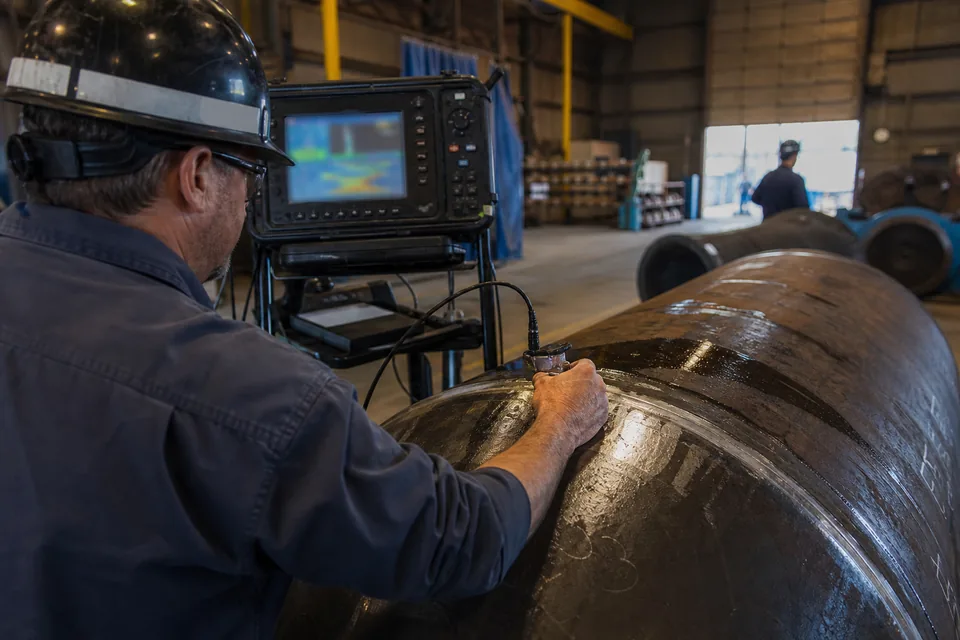
Which method inspects which part of a boiler
| Boiler part | Method | What it finds | Typical US range per boiler |
|---|---|---|---|
| Waterwall and generating tubes | UT thickness grid, EMAT | Wall loss, fireside corrosion, erosion, hydrogen damage | $1,500 to $15,000 |
| Superheater and reheater tubes | UT thickness, borescope, replica or hardness checks | Creep damage, overheating, thinning at supports | $2,000 to $20,000 |
| Steam drum and mud drum welds | MT, PAUT or TOFD | Cracks at nozzle and seam welds, fatigue damage | $1,500 to $8,000 |
| Headers and stub tubes | MT, PT, borescope | Cracking at ligaments and stub welds, internal deposits | $1,200 to $6,000 |
| Economizer tubes | UT thickness, visual | Acid dew point corrosion, fly ash erosion | $1,000 to $6,000 |
| Refractory and casing | Infrared survey | Hot spots, refractory loss, leaks | $500 to $1,800 |
| Boiler feed and steam piping | UT thickness, radiography on repairs | Flow accelerated corrosion, weld defects | $800 to $5,000 |
These are planning ranges, not quotes. Boiler size, fuel, tube count, access and the report you need change the real price, and a full outage campaign costs less per tube than a call out for one failed tube.
NBIC, ASME Section I and your state inspector set the rules
Power boilers are built to ASME Section I and heating boilers to Section IV. In service inspection, repair and alteration follow the National Board Inspection Code, which the National Board of Boiler and Pressure Vessel Inspectors publishes and most states adopt. Most jurisdictions require a certificate inspection of power boilers every year, done by a commissioned inspector from the state or from your insurer, and often every two years for low pressure heating boilers. Exact intervals and exemptions differ by state, so confirm yours with the jurisdiction. NDT is usually the extra work that answers a specific question for that inspector, such as how much wall is left on the waterwall tubes or whether a drum weld has cracked. For the underlying method see ultrasonic testing services, and for process vessels attached to the same plant see pressure vessel inspection services.
Tube failures are the reason most boiler NDT is ordered
Boiler tube leaks are the leading cause of forced outages in many plants, and they usually come from damage that was measurable months earlier. Fireside corrosion and erosion thin tubes from the outside, waterside deposits cause underdeposit corrosion and overheating, and thermal fatigue cracks the welds where tubes meet headers. A UT thickness grid or an EMAT scan gives you a map of remaining wall per tube, so you can replace the worst 5 percent at the next outage instead of the whole panel after a failure. Repeat the same grid points each year and the corrosion rate falls out of the data. A borescope pushed into headers and drums shows deposits and cracking that no outside method sees, see borescope inspection for how that works.
Who buys boiler inspection services
Plant engineers in food, paper, chemical, hospital and university plants buy annual boiler NDT to support the jurisdiction inspector and the insurer. Power producers and cogeneration operators schedule tube thickness and weld programs around planned outages. Waste to energy and biomass plants, where fireside corrosion is severe, order tube mapping every year. Boiler repair contractors and fabricators order MT, PT and radiography on repair welds before the inspector signs the repair report. Our power plant inspection page covers turbines, switchgear and wind assets in the same plant.
How a boiler inspection job runs
- You send boiler type, pressure, fuel, year built, tube material, the last inspector report and any known leaks.
- The inspection company proposes a plan: which tubes and welds, which methods, crew size and access. Internal work needs the boiler cooled, drained, locked out and cleaned of loose scale.
- Crews mobilize, complete site safety steps and inspect in the agreed outage window. Boiler drums and furnaces are confined spaces, so a permit, an attendant and a rescue plan are required.
- Data is reviewed by a qualified technician and the inspector, who flags tubes for replacement and welds for repair.
- You receive a report with thickness maps, weld results, a defect list, corrosion rates and recommended repairs. Urgent findings are called in the same day.
What boiler inspection costs
Cleaning, scaffolding and downtime often cost more than the inspection itself. Ask whether the quote includes them.
- UT thickness or EMAT scan of waterwall tubes. $1,500 to $15,000 depending on tube count and access.
- MT of drum and header welds. $1,500 to $8,000 with surface preparation.
- PAUT or TOFD of thick drum seams. $1,500 to $6,000 per seam set.
- Borescope of headers and drums. $600 to $3,500.
- Radiography of repair welds. $60 to $250 per weld in the field.
- Mobilization and travel. $500 to $3,000 per trip for remote plants.
Standby during permits, night shifts and rush reports add to these numbers. Ask each contractor to list them separately so quotes compare like for like. Our NDT inspection cost guide shows how crews price the underlying methods.
What to put in your boiler inspection RFQ
- 01Site, number of boilers and a data sheet for each: type, design pressure, steam output, fuel, year built and tube material.
- 02Scope per boiler: waterwall, superheater, economizer, drums, headers, feed piping.
- 03Code and rules: NBIC, ASME Section I or IV, your state jurisdiction and any insurer requirements.
- 04Date and findings of the last inspection, previous tube leaks and repairs.
- 05Access: scaffolding, platforms, who cleans the furnace and who supplies power and lighting.
- 06Deliverables, such as thickness maps per tube, weld images, a replacement list and a spreadsheet.
- 07Outage window, shifts and permit rules.
- 08Qualifications required: ASNT Level II for each method, a commissioned inspector where the code requires one, and insurance limits.
How to choose a boiler inspection company
Check that technicians hold ASNT SNT-TC-1A or CP-189 Level II certification in the methods quoted, and that the company has boiler specific experience such as waterwall mapping or EMAT. Ask for a sample report on a boiler like yours and how they reference tube locations so next year's scan lines up. Confirm the confined space program, injury record and insurance, and how quickly first data is delivered after the crew leaves site. Compare quotes on the same tube count and report format, not on the headline number.
FAQ
How much do boiler inspection services cost?
Boiler NDT in the US usually costs $1,500 to $8,000 for a package boiler and $10,000 to $60,000 for a utility scale unit during an outage. Scaffolding, cleaning and downtime are billed separately and can exceed the inspection itself.
How often must a boiler be inspected?
Most US states require a certificate inspection of power boilers every year and of low pressure heating boilers every one to two years, done by a commissioned inspector. Intervals and exemptions vary by jurisdiction, so check with your state boiler office.
What NDT methods are used on boilers?
Ultrasonic thickness and EMAT measure tube wall loss, magnetic particle and dye penetrant testing find surface cracks on welds, PAUT and TOFD size flaws in thick drum seams, and a borescope inspects headers and drums. Radiography records repair welds.
Can boiler tubes be inspected while the boiler is online?
Rarely. Tube thickness work needs the boiler cooled, locked out and opened so crews can reach the tubes. Some external checks such as infrared surveys and casing leak detection can be done online, but tube and weld NDT waits for an outage.
Who does a boiler inspection?
A commissioned boiler inspector from the state or an insurer performs the statutory inspection. NDT technicians certified to ASNT Level II do the UT, EMAT, MT and PAUT work and report to that inspector or to your plant engineer.
Get matched with boiler inspection companies
Describe the boiler in the inspection method advisor, with type, pressure, fuel and inspection history. It picks the methods that answer your question, builds a complete request for quote and sends it to NDT companies that list those methods and cover your state. You compare quotes on the same scope instead of repeating the job description to each vendor.
- 01What needs inspecting
- ...
- 02Material
- ...
- 04Concern
- ...
Run an inspection company that serves boiler plants? List your company
Show your UT, EMAT, PAUT and borescope capability, your certified technicians and the states you cover, and receive matched boiler inspection RFQs. Learn more for providers.