What MFL scanning finds and where it is used
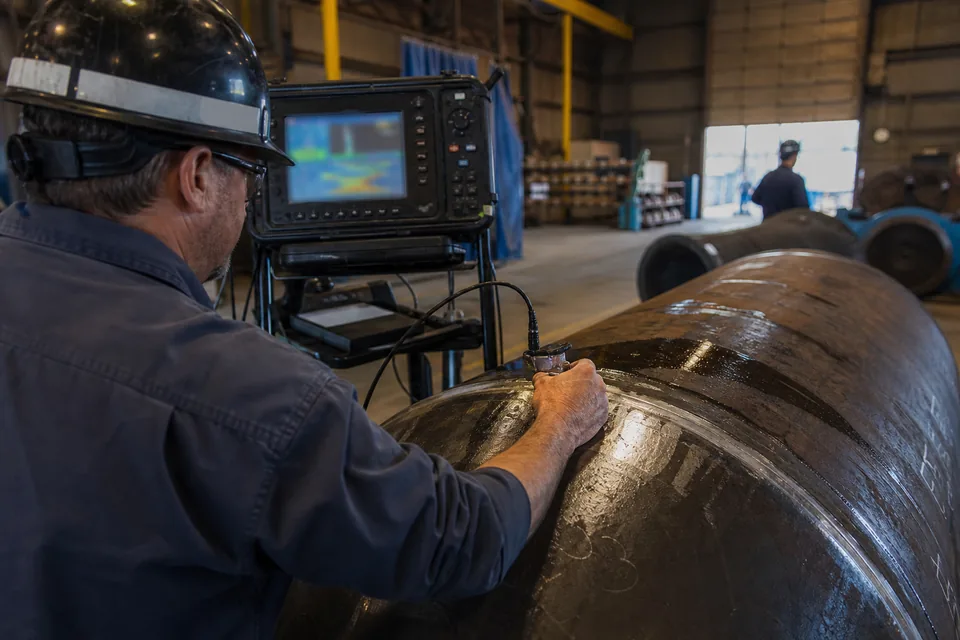
An MFL tool carries magnets that saturate the plate, and sensors between the poles record disturbance where the wall is thinner. On tank floors, a hand pushed or motorized scanner covers the plates and flags underside corrosion that a visual inspection cannot see. On pipe, in line tools and external scanners use the same principle. MFL ranks indications by depth but is not a precise thickness gauge, so every reportable indication is normally proven with ultrasonic thickness readings. The method is permitted for floor inspection under API 653, which is why tank owners buy it. Coverage near the shell, at lap welds and on heavily pitted or coated plate is limited, and each tool has a thickness range, so ask the provider about both before you accept a quote.
MFL testing prices by job type
These are planning ranges built from how US inspection companies structure quotes, not published price lists. Real quotes move with access, cleaning, location and minimum charges.
| Job | Planning range | What it includes |
|---|---|---|
| Tank floor MFL scan | $1.00 to $2.50 per sq ft | Scan of accessible plate area, indication map, preliminary report |
| UT verification of indications | $150 to $250 per hour of technician time, or $1,000 to $3,000 per tank | Thickness readings at flagged areas, pit depths |
| Annular ring and edge areas | $400 to $1,200 per tank | Manual UT or short range scan where the scanner cannot reach |
| Report with API 653 remaining life | $800 to $2,500 | Corrosion rate, minimum remaining thickness, next inspection interval |
| Mobilization and minimum | $1,500 to $3,500 per day, one crew | Travel, setup, and the daily minimum on small jobs |
| External pipe scanner, small bore | $8 to $25 per ft | Scan with corrosion mapping on exposed pipe |
| In line inspection of pipelines | Priced per mile, see inline inspection pipeline cost | Tool run, data analysis, dig list |
Tank cleaning and floor preparation are the largest items outside these ranges. MFL needs a clean floor free of loose scale and sludge, and the tank must be out of service and gas free.
Worked budget for an 80 ft diameter tank floor
A terminal owner schedules an API 653 internal inspection on an 80 ft diameter carbon steel tank with a 1/4 inch floor.
- Floor area is pi times 40 squared, about 5,027 square feet, and about 4,500 square feet is scannable after leaving margin at the shell and obstructions.
- MFL scan at $1.00 to $2.50 per square foot on 4,500 square feet, about $4,500 to $11,250.
- UT verification of flagged indications, about $1,000 to $3,000.
- Annular ring and edge manual UT, about $400 to $1,200.
- Report with remaining life, about $800 to $2,500.
Added together the range is about $6,700 to $17,950, so plan on roughly $7,000 to $15,000 depending on how many indications the scan finds. If the floor has deep pitting, the UT line grows and the owner may decide to replace plates, which is a repair job and a separate vacuum box testing bill for the new floor seams. Compare this with spot UT on a grid, which can be cheaper on a small floor but covers only a fraction of the plate. For the full tank program see API 653 tank inspection cost.
What drives the price of MFL testing
- Floor condition. Scale, sludge and coating slow the scanner and can cut sensitivity.
- Plate thickness. Thick plate and double bottoms reduce detection of underside pits, so a different tool may be needed.
- Tank size and obstructions. Roof supports, sumps and piping cut the scannable area.
- Data analysis depth. A map with indications ranked by depth costs less than a full remaining life study.
- Verification scope. Every indication that crosses the acceptance threshold needs ultrasonic readings.
- Access and permits. Confined space entry, standby personnel and gas testing add days.
For other tank methods and the frame around them, see storage tank inspection services, and for how other methods compare in price see NDT inspection cost.
When to buy MFL and when ultrasonic thickness testing is enough
Buy MFL when the floor is large, the history shows underside corrosion and you want to know where the damage is before spending on repairs. Buy ultrasonic thickness testing when the area is small, the plate is accessible from both sides, or you need a precise remaining thickness for a calculation. Many owners buy both, with MFL as the screen and UT as the proof. See ultrasonic thickness testing services for the grid based option. The governing document for tank floor inspection is API 653, and your authorized inspector decides which method and which acceptance criteria apply.
What to put in your MFL testing request for quote
- Tank diameter, floor plate thickness, floor type (single, double bottom, lined) and coating.
- Product stored, last inspection date and the corrosion rate from the previous report.
- Whether the tank is cleaned and gas free or the quote must include cleaning.
- Verification scope: UT on every indication or only those above a stated depth.
- Report format, API 653 remaining life calculation and who signs.
- Shutdown window and confined space rules.
How much does magnetic flux leakage testing cost?
A tank floor MFL scan runs roughly $1.00 to $2.50 per square foot, with follow up ultrasonic checks and a report adding a few thousand dollars. An 80 ft diameter floor typically totals $7,000 to $15,000 before cleaning, depending on how many indications the scan flags.
How accurate is MFL testing?
MFL finds and ranks corrosion by depth, but it is a screening method rather than a thickness gauge. Accuracy depends on plate thickness, surface condition and the tool. That is why indications above the acceptance threshold are proven with ultrasonic thickness readings before repair decisions.
Does MFL testing replace ultrasonic testing on tank floors?
No. MFL covers the plate quickly and finds where damage is, and ultrasonic testing measures how much metal remains at those spots. Most tank floor programs use MFL to screen and UT to verify, and spot UT alone is used mainly on small floors.
Can MFL scan through coatings?
Thin coatings are usually acceptable, and thick or heavily blistered coatings reduce sensitivity and should be removed or discussed with the provider. Loose scale and sludge must be cleaned off because the scanner has to ride flat on the plate.
Can I get MFL testing done while the tank is in service?
Floor MFL needs the tank emptied, cleaned and made safe for entry, so it is done during an out of service inspection. Pipe and shell checks on exposed steel can sometimes be done in service with external scanners, but floor work cannot.