Helium leak testing services for vessels, tubes and sealed parts
IndustrialImaging matches your leak test to inspection companies that run helium mass spectrometer testing in your region. Helium leak testing services find leaks that bubble tests and pressure decay miss, down to rates measured in cubic centimeters per second, by detecting helium that escapes through a defect. Plants buy it for heat exchanger tube leaks, vacuum chambers, sealed housings, refrigeration and semiconductor equipment, and for any part with a written leak rate limit. Describe the part and the required leak rate once, and the request goes to companies with the right test equipment.
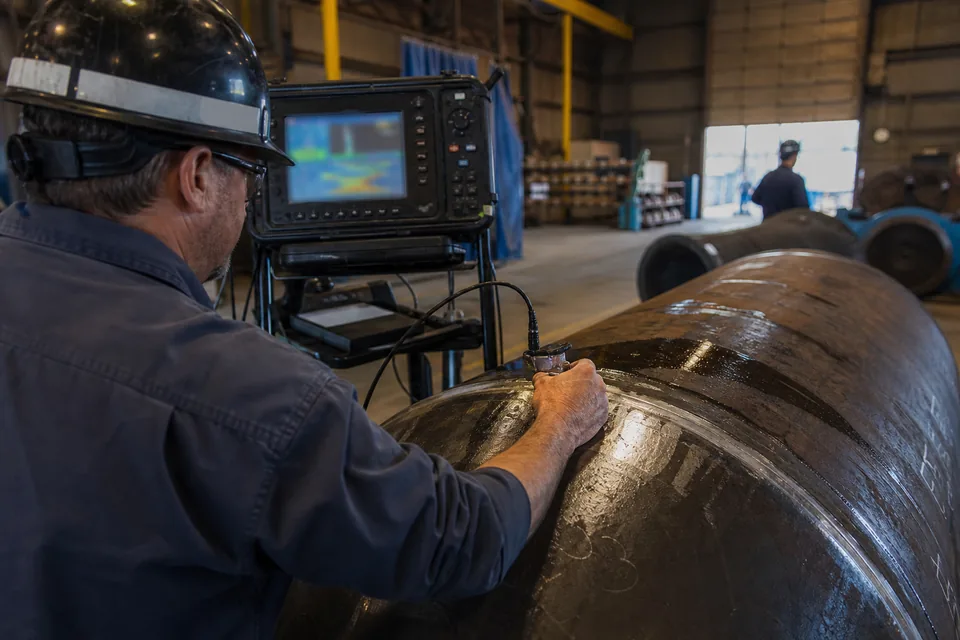
What a helium leak testing job covers
| Method | How it works | What it finds | Typical use |
|---|---|---|---|
| Sniffer test | Part is pressurized with helium, a probe is moved over welds and joints | Location of a leak on a pressurized part | Pressure vessels, piping, heat exchanger tube sheets |
| Vacuum (spray) test | Part is evacuated and connected to the detector, helium is sprayed outside | Location of leaks in vacuum systems | Vacuum chambers, furnaces, process vessels |
| Hood or chamber test | Part is evacuated or pressurized inside a helium enclosure | Total leak rate of the whole part | Sealed housings, valves, pumps, tooling |
| Accumulation test | Helium collects in a bag or box around the part | Pass or fail on total leak rate | Production sampling, large sealed assemblies |
| Tube bundle test | Helium on one side, detector probes on the tube ends | Which tubes or tube to tubesheet joints leak | Heat exchangers and condensers |
A helium test answers a different question than a pressure or hydrostatic test. Hydrotest proves strength and gross tightness, helium proves tightness at a stated leak rate. For code pressure testing see hydrostatic testing services, and for exchangers see heat exchanger inspection services.
Where the leak rate requirement comes from
The test procedure follows ASME Boiler and Pressure Vessel Code Section V, Article 10 on leak testing, which covers the bubble, pressure change and tracer gas methods including mass spectrometer testing. The acceptable leak rate is not set by the method. It comes from your drawing, specification or customer, for example a vacuum chamber that must hold below a stated rate or a vessel that must not leak a regulated gas. State the number and the unit in the request, because it decides which method and which detector the crew brings. The code text is published by ASME.
Who buys helium leak testing services
- Plant engineers with a heat exchanger or condenser that loses vacuum or cross contaminates product and needs the leaking tubes found.
- Fabricators of vacuum chambers, furnaces and process vessels who must prove a leak rate before delivery.
- Equipment makers in refrigeration, semiconductor, medical and aerospace who test sealed assemblies.
- Maintenance managers recommissioning a system after a repair or retube.
- Quality managers whose customer specification names a helium leak rate and a witnessed test.
- Owners of gas and cryogenic systems who need a documented tightness test.
Who helium leak testing services are for
They fit parts and systems with a defined leak rate, a vacuum requirement or a leak you cannot find with soap solution. They are the wrong buy when you only need a code pressure proof, where a hydrostatic or pneumatic test is cheaper and what the code asks for. They are also not a way to measure corrosion or wall loss, for that see ultrasonic thickness testing services.
How a helium leak testing job runs
- You send the part drawing or description, the required leak rate, the test pressure or vacuum and the location.
- The provider selects the method, sniffer, vacuum, hood or tube bundle, and confirms detector sensitivity and calibration.
- The crew isolates and prepares the system, installs the helium supply and detector, and calibrates against a reference leak.
- Leaks are located, marked and measured, you repair them, and the part is retested.
- You receive a report with the method, calibration, measured leak rate, leak locations and the final pass result.
What drives the price of helium leak testing
- Method. A sniffer scan of a few welds is a half day job, a full tube bundle test or a hood test of a large vessel takes much longer.
- Required leak rate. Tighter limits need a mass spectrometer with a vacuum setup and a cleaner system.
- Part size and number of joints. More tubes, flanges and welds mean more probing time.
- Preparation. Draining, drying, blanking flanges and installing test connections are often more work than the test itself.
- Retests. Repair and retest cycles add days, and a clear quote says how each retest is priced.
- Site and mobilization. Field work at a distant plant is priced by the trip and a daily minimum, shop testing is priced per part.
For the range of method prices see NDT inspection cost, and for the other tube side method see eddy current testing services.
What to put in your helium leak testing request for quote
- 01Part type and size, material and the number of joints, tubes or welds in scope.
- 02Required leak rate with its unit, and the document that sets it.
- 03Whether the part can be evacuated, pressurized or both, and the maximum pressure.
- 04Location, shop or field, and access to the part.
- 05Preparation: who drains, dries and blanks the system.
- 06Report requirements, witness needs and the repair and retest plan.
How to choose a helium leak testing company
Ask which detector the crew uses and when it was last calibrated against a reference leak, because every number in the report depends on it. Confirm the technician holds a leak testing qualification under the written practice you accept and has run the method you need. Ask how the quote handles preparation and retest, and whether the crew can also find the leak by tube bundle probing if a total leak rate test fails. Prefer a quote that lists mobilization, setup, test time and retest as separate lines so two quotes compare directly.
FAQ
What is helium leak testing used for?
Helium leak testing finds and measures leaks too small for bubble or pressure decay tests. It is used on heat exchanger tubes, vacuum systems, sealed housings and any part with a written leak rate limit, and it can both locate a leak and measure the total leak rate of a part.
How sensitive is helium leak testing?
A mass spectrometer helium test detects leak rates many orders of magnitude smaller than a soap bubble test, and the usable sensitivity depends on the method, the setup and the background helium. State your required leak rate in the request so the crew selects a method that can prove it.
What does helium leak testing cost?
Cost depends on the method, part size, preparation and retests, and small field jobs are priced mostly by mobilization and the daily minimum. A request through the advisor gets quotes for your own part on one scope.
Can helium leak testing find leaking heat exchanger tubes?
Yes. With helium on one side and a detector at the tube ends, the crew finds which tubes or tube to tubesheet joints leak. The leaking tubes are then plugged or the bundle is repaired, and the exchanger is retested.
Is helium leak testing the same as a hydrostatic test?
No. A hydrostatic test proves strength and gross tightness at a code pressure, while a helium test proves tightness at a stated leak rate. Many parts get both, hydrotest for the code and helium for the leak rate requirement.
Get matched with helium leak testing companies
Open the inspection method advisor, enter the part, the leak rate and the location, and it builds a complete request for quote for NDT companies in your region. You compare quotes on the same scope instead of describing the part to each company. Browse every method on the NDT companies page, or see the neighboring method in vacuum box testing services.
- 01What needs inspecting
- ...
- 02Material
- ...
- 04Concern
- ...
Run an NDT company? List your company
Show your leak testing crews and the states you cover, and receive vessel, exchanger and sealed part requests that fit your equipment. Learn more for providers.