Reverse engineering services and 3D scan to CAD for legacy parts
Reverse engineering services capture a physical part with a 3D scanner and rebuild it as a CAD model you can machine, mold or 3D print from, with no drawing needed. The result is either a mesh (STL), a surface model or a fully parametric solid in STEP, SolidWorks or Inventor format, checked against the scan within a stated tolerance. In the US, a simple part usually costs $800 to $3,000 to reverse engineer and a complex part or assembly $3,000 to $15,000 or more, with delivery in one to four weeks. Describe the part once and compare quotes from matched metrology shops.
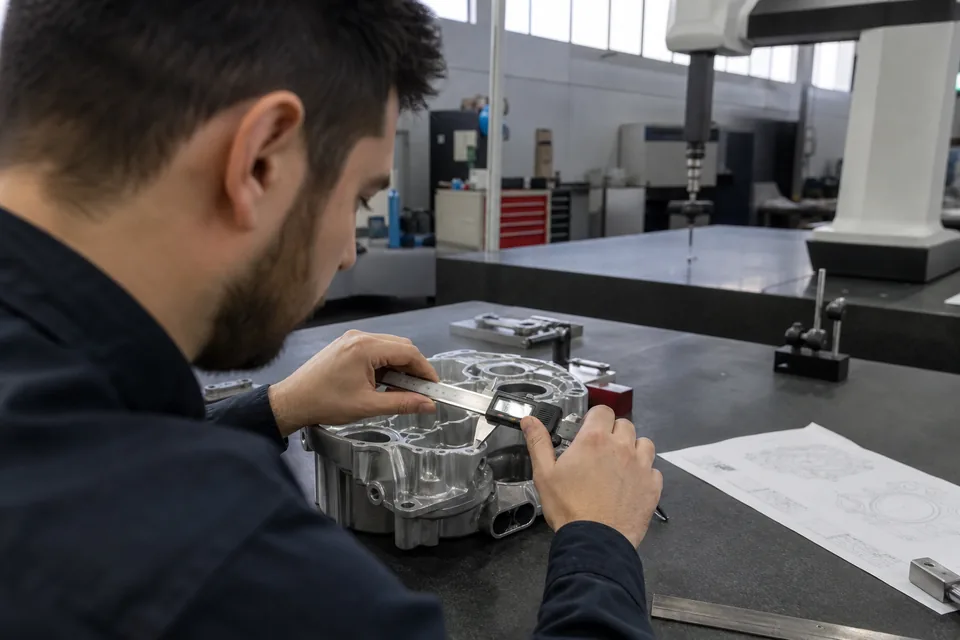
What reverse engineering delivers
- Scan data and mesh (STL, OBJ or PLY). The raw capture, useful for 3D printing, visualization and inspection, but it cannot be edited like a CAD model.
- Surface model (STEP or IGES). Smooth surfaces fitted over the scan. Good for freeform shapes such as housings, blades and molds.
- Parametric solid model (STEP, SolidWorks, Inventor, Creo or NX). An engineer rebuilds planes, cylinders, holes and fillets as editable features with dimensions. This is what a machine shop or a design team normally needs.
- 2D drawings with dimensions and tolerances, produced from the solid model, for shops that work from prints.
- Deviation report. A color map and a table of the CAD model against the scan, which proves the rebuilt model is within tolerance of the real part.
Ask which of these is in the price. A mesh costs hundreds, a parametric model with drawings costs thousands, and mixing them up is the main reason quotes do not compare.
How the part gets scanned
Which scanner a shop uses depends on size, material and the accuracy you need. Our 3D scanning services page compares all of them in detail.
- Structured light scanners capture small to medium parts at accuracy around 0.02 to 0.05 mm, and are the usual choice for precision machined and cast parts.
- Handheld laser scanners handle larger parts, tooling and assemblies, and work on site. Accuracy is typically around 0.03 to 0.1 mm.
- Tactile CMM probing records exact diameters, datums and flatness when you need tolerances, not shapes. Shops often combine it with a scan.
- Industrial CT scanning is used when features are hidden inside, for example internal channels of a casting. See industrial CT scanning.
Who buys reverse engineering
Maintenance and reliability teams order it for obsolete parts when the original manufacturer has gone out of business and a spare is on a six month lead time. Machine shops and job shops buy it when a customer sends a worn sample instead of a drawing. Tooling and mold makers use it to rebuild a mold from a master. Product teams and startups use it to capture a clay model or a competitor's part for form and fit. Aerospace, energy and food processing plants use it for legacy line equipment that has no digital record. Each of these buyers needs a firm price, a tolerance in writing and a file their CAD software opens without repair.
How a reverse engineering job runs
- You describe the part, the quantity, the material and what the model is for. Photos and the function of the part help the shop decide how much of it is critical.
- The shop confirms the scan method and the tolerance that matters. Critical dimensions such as bores, mating faces and threads get a tighter requirement than cosmetic surfaces.
- The part is shipped or scanned on site. Reflective, black or transparent parts may need a developer spray, which the shop handles.
- An engineer builds the CAD model from the scan, then checks it back against the scan.
- You get the files, the deviation report and drawings if ordered. One round of revisions is normal.
Simple parts often come back in one to two weeks. Assemblies with many components can take four weeks or longer.
What reverse engineering costs
These are typical US planning ranges, not quotes. Part size, complexity, tolerance and the deliverable set the real price.
| Job type | Typical range, not a quote |
|---|---|
| Scan only, small part, mesh delivered | $300 to $1,200 |
| Simple prismatic or turned part to parametric CAD | $800 to $3,000 |
| Complex part with freeform surfaces to CAD | $3,000 to $8,000 |
| Assembly of several components to CAD | $5,000 to $15,000 or more |
| 2D drawings with tolerances, per part | $150 to $800 |
| On site scanning, per day | $1,200 to $3,000 |
| Rush delivery | Often +25 to 50 percent |
Price per part falls when you order several related parts together, because setup and CAD time are shared. The deeper breakdown of line items sits in our 3D scanning services cost guide.
What to put in your reverse engineering RFQ
- 01The part itself or photos with a scale, and the approximate size and weight.
- 02Material and finish, especially if the surface is shiny, black or soft.
- 03What the model is for, such as machining, casting, injection molding, 3D printing or inspection.
- 04The CAD format and software version you need, for example STEP AP214 or SolidWorks 2024.
- 05Parametric or surface model, and whether drawings with tolerances are required.
- 06Tolerance that matters and critical features such as bores, threads or mating faces.
- 07Quantity of parts, any related parts for the same job and the delivery date.
- 08Whether the part is shipped in or the shop has to scan on site.
How to choose a reverse engineering company
Look for a shop that shows a deviation report from a past job, not only a scan photo. Ask whether the CAD engineer will build the model in your software and whether files come as native or STEP. Confirm who owns the data, since some shops keep copies, and check that your part is not covered by someone else's patent or restricted by export rules. For a part that must fit a mating component, ask to receive tolerance on the critical features in writing. Our NDT companies page shows how to compare providers on scope instead of the lowest unit price alone.
FAQ
What are reverse engineering services?
Reverse engineering services scan a physical part with a 3D scanner and rebuild it as a CAD model that you can manufacture from. The deliverable can be a mesh, a surface model or a fully editable parametric solid, plus a deviation report that proves the model matches the part.
How much does reverse engineering a part cost?
In the US, a simple part usually costs $800 to $3,000 to reverse engineer into parametric CAD, a complex part $3,000 to $8,000 and an assembly $5,000 to $15,000 or more. A scan with only a mesh delivered costs $300 to $1,200. Rush work often adds 25 to 50 percent.
How accurate is 3D scan to CAD?
Structured light scanners capture parts at about 0.02 to 0.05 mm, and the CAD model is then rebuilt to a tolerance you agree in advance, often 0.05 to 0.2 mm on non critical surfaces. A deviation report shows the real difference between the model and the scan.
Can you reverse engineer a part without a drawing?
Yes, that is the usual case. The shop scans the part, rebuilds its features in CAD and delivers drawings if you ask for them. Worn or damaged parts need a decision about whether to model the part as found or restore its original dimensions.
How long does reverse engineering take?
Simple parts typically take one to two weeks from receipt of the part to delivery of the CAD files. Complex freeform parts take two to four weeks, and large assemblies can take longer. Rush service shortens this for an extra charge.
Get matched with reverse engineering shops
Describe your part in the inspection method advisor: size, material, quality of the surface and what the model is for. It checks whether a scan, a CMM probe or CT answers your question, then turns your answers into a complete request for quote and sends it to scanning and metrology shops that list reverse engineering and your service area. You compare quotes on the same scope instead of explaining the part five times.
- 01What needs inspecting
- ...
- 02Material
- ...
- 04Concern
- ...
Run a scanning shop that reverse engineers parts? List your company
Show your scanners, accuracy, CAD software and industries, and receive matched reverse engineering requests. Learn more for providers.